
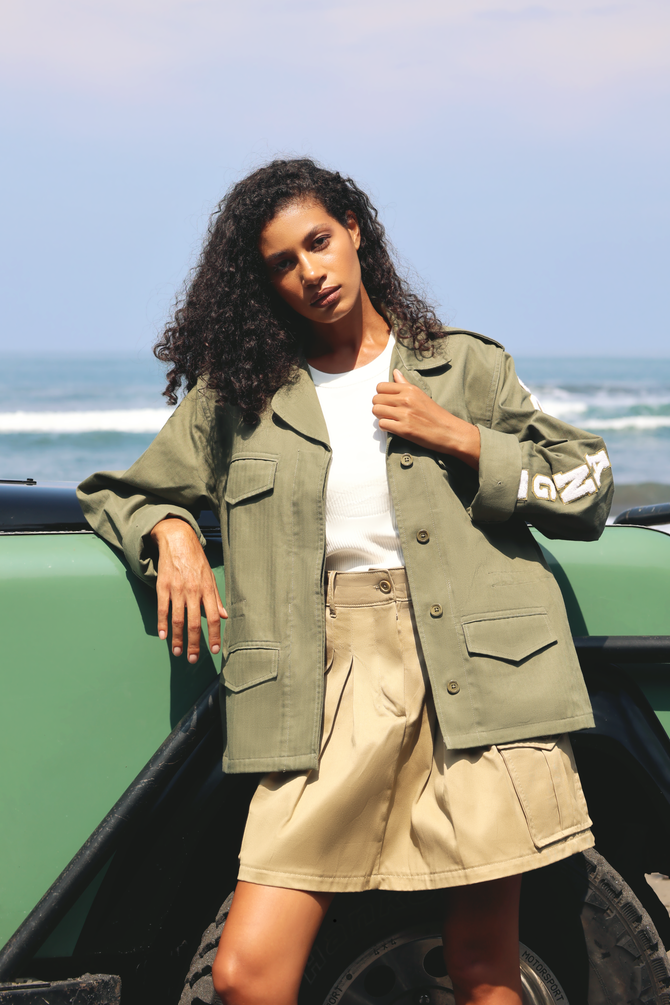


The deck jacket. A name that smells of the open sea, the spray, the deck of a wind-swept ship. Few garments carry such a rich history, so deeply rooted in reality — and yet, the deck jacket remains one of the most overlooked pieces of the male wardrobe. Wrongly so.
Origins: the decks of warships
The deck jacket, or « veste de quart » in French, was born on the ships of the French Navy and the Royal Navy at the beginning of the 20th century. Watch officers — those who kept vigil on deck, night and day, in all weathers — needed a garment worthy of their mission: warm, waterproof, and loose enough to allow quick movements.
The solution was a double-breasted jacket in thick wool cloth, lined with cotton or silk, with an officer collar that could be turned up to protect the neck. The buttons were horn or metal — never plastic, which didn't yet exist — and the cut was straight, functional, with no frills.
What sets the deck jacket apart from the classic military pea coat is its versatility. It wasn't a parade uniform: it was a work garment, worn by men who spent eight hours at a stretch facing the sea, scanning the horizon.
From the Navy to the street: civilian appropriation
Like many military garments — the trench coat, the peacoat, the safari jacket — the deck jacket was adopted by civilian wardrobes in the post-war years. Military surplus, sold at low prices, allowed an entire generation to discover this piece of unique character. Students, artists, writers wore it for its look that was both nonchalant and impeccably structured.
Today, the deck jacket is experiencing renewed interest, driven by the return of utilitarian clothing and the quest for pieces with soul. It's not a blazer, it's not a peacoat, it's not a trench — it's something else. A presence. A quiet authority.
How to wear the deck jacket today
The deck jacket is worn as it was designed: without fuss. Over a fine turtleneck, it replaces the coat for mid-season days. Over an oxford shirt and raw denim, it gives an immediate look without apparent effort.
In its modern version, it welcomes cashmere — for incomparable warmth — or water-repellent gabardine, which stays true to its original function while lightening it. Navy tones — midnight blue, black — remain the great classics. Lighter versions, in beige or grey wool cloth, bring a welcome touch of contrast.