

Women's Safari Jacket: The Guide to Choosing an Iconic Piece and Wearing It with Style
The women's safari jacket is one of those rare wardrobe pieces that transcends fashion without ever losing its aura. Born in the 1930s on the shoulders of explorers, democratised by Yves Saint Laurent in 1968 and worn ever since by all women who love understated elegance, it perfectly embodies the spirit of the chic adventurer. Yet you still need to choose it well, because behind the word "safari jacket" today lie cuts, fabrics, and qualities of very uneven standard. In this guide, we cover the essentials: what defines a true safari jacket, how to recognise a quality piece, which colours and silhouettes to favour, and above all how to wear it just as well on the streets of a capital city as by the seaside. A well-chosen safari jacket means ten seasons of guaranteed elegance — and a clothing investment in the noblest sense of the term.
What is a true women's safari jacket?
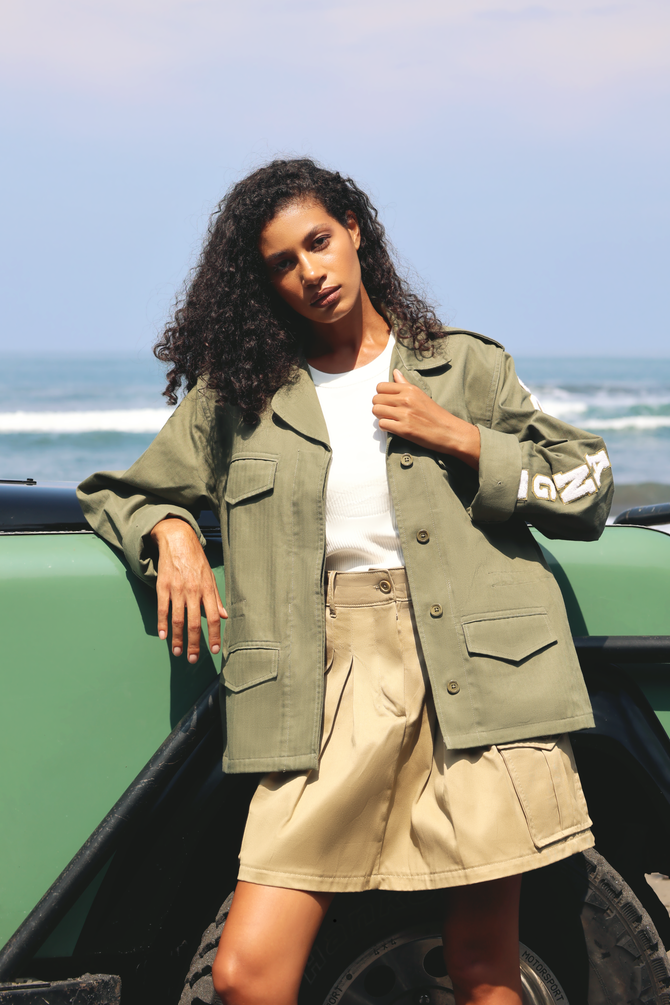
The safari jacket was originally a lightweight jacket designed for expeditions in hot climates: hard-wearing cotton fabric, fluid cut, long but airy sleeves, and above all four pleated bellows pockets — two on the chest, two on the hips — which are its absolute signature. It is also characterised by a belt (or a martingale) that defines the waist, a classic shirt collar, and buttons that are often covered or in corozo.
It is these functional details, inherited from the colonial uniform and then from the safari, that give the piece its full character. A jacket without bellows pockets, without a belt, or without structured shoulders is not a safari jacket but a simple lightweight jacket. The distinction matters: it is precisely this architecture that enhances the female silhouette, defining the waist while elongating the torso. To understand the safari DNA and related pieces, our dossier on the men's cotton safari jacket retraces the codes common to both silhouettes.
Recognising a quality safari jacket: five infallible criteria
The fabric. A true safari jacket is cut from a tightly woven cotton (gabardine, heavy poplin) or a good-weight cotton-linen blend (200 to 280 g/m²). Beware of predominantly synthetic compositions: they betray the cut and lose their drape after a few washes.
The pockets. Four pleated bellows pockets, closed by a buttoned flap, lined on the inside. This is the hallmark. If the pockets are simply piped, it is not a safari jacket.
The belt. A fabric belt, passing through sewn loops, allows the waist to be adjusted. A safari jacket without a belt does not have the same stance: it floats without cinching.
The finishes. Turn the jacket inside out. Bound seams, regular topstitching, a clean collar lining, buttons sewn on firmly (ideally in corozo, mother-of-pearl, or fabric-covered): these details immediately distinguish a workshop piece from an industrial production.
The origin. A safari jacket crafted in France or Europe, with clear traceability from thread to assembly, guarantees you several years of longevity. This is the criterion that weighs most heavily over time.
The cuts that flatter every silhouette
The safari jacket now comes in several cuts, and not all of them suit every body shape. Here are the four main ones.
The classic belted cut. This is the most universal version, faithful to the Yves Saint Laurent spirit: defined waist, mid-thigh length, slightly flared. It flatters X, A, and H silhouettes, and elegantly defines the waist of O body shapes thanks to the belt.
The straight long cut. More modern, without a belt (or with a removable belt), it falls to mid-calf and resembles a light trench. Ideal for V-shaped silhouettes or for those who prefer not to define the waist.
The short cropped cut. More sporty, ending at the hip. Very flattering on long-limbed silhouettes, to wear with high-waisted trousers to rebalance the proportions.
The oversized cut. Boyfriend spirit, dropped shoulders, loose belt. More contemporary but true to the safari spirit when the fabric is noble. Avoid on petites, where it can overwhelm.
Whatever the cut, two rules stand: favour a length that ends above the knee (except for trench-style cuts), and ensure that the shoulder seam falls right at the point — a poorly positioned safari jacket loses all its allure.
The timeless colours to favour
The safari jacket draws its elegance from natural shades, inherited from the desert and tropical regions. Four colours traverse the seasons without ever tiring.
Khaki (from light sand to deep khaki) is the historical colour, the most emblematic. It pairs with absolutely everything and immediately gives that chic adventurer allure. Sandy beige or string brings more softness, perfect on fair skin and ideal for spring. Off-white or ecru transforms the safari jacket into a solar, almost summery piece, to wear over a linen dress or white jeans. Finally, black or navy modernises the piece and makes it compatible with more formal urban use.
However, avoid highly saturated colours (red, bright yellow) and loud prints: the safari jacket is a piece that must converse with accessories, not steal the show. Its beauty lies in the subtlety of its fabric and the precision of its cut.
How to wear the women's safari jacket: three silhouettes to reproduce
For day, the clean urban version. Belted khaki safari jacket, organic cotton white T-shirt, raw straight jeans, fine natural leather belt, leather loafers or derbies. A messenger bag or wicker basket completes the look. This is the perfect silhouette for a city lunch, a creative office day, or a market stroll.
For the seaside, the chic adventurer version. Light sand safari jacket, ecru linen dress or wide linen trousers, flat espadrilles, Panama hat. You can draw inspiration from our guide to styling the safari jumpsuit in summer: the same logic of fluidity, natural materials, and sandy tones applies perfectly to the safari jacket. This silhouette, timeless, traverses the decades without a wrinkle.
For evening, the elegant version. Black or navy safari jacket, silk camisole or fluid camisole top, flowing trousers or satin midi skirt, fine sandals, leather cuffs, and discreet jewellery. The safari jacket is not reserved for day: worn close to the body, in a noble fabric, it rivals the most codified formal jackets. To go further into the codes of military style in the warm season, read our guide to military style in summer.
Safari jacket, trench coat, safari vest: how not to confuse them?
Three neighbouring but distinct pieces. The trench is longer (mid-calf), without pleated bellows pockets, has a storm flap, and is designed for British rain. The safari vest is a broader term covering all colonial-inspired jackets, of which the safari jacket is the best known. The safari jacket, for its part, is recognised by its specific cut: belt, four bellows pockets, mid-thigh length, and an undeniable kinship with the North African military uniform.
In practice, these three pieces complement each other in a well-constructed wardrobe: a trench for wet seasons, a safari jacket for spring and summer, a safari vest or a shorter jacket for transitions. To explore the subject further, our complete guide to women's linen trousers will give you the right foundations for composing a coherent summer silhouette — trousers and safari jacket together.
Caring for your safari jacket to keep it for ten summers
A well-made safari jacket requires little care but a few good habits. Brush it regularly dry with a soft brush to remove dust and fibres. Wash it at 30°C maximum, inside out, with a mild detergent and no fabric softener. Avoid the dryer: hang it damp on a thick hanger and pull it at the seams so it dries in shape.
If you iron, do it inside out, on a hot iron with a pressing cloth to avoid shining the fabric. For localised stains, treat immediately with a little soapy water rather than washing the whole garment. Stored on a suitable hanger out of season, your safari jacket will keep its structure and silhouette for years — and will patina beautifully, like all fine cotton pieces.
The Coulange safari jacket: French elegance from the adventure wardrobe
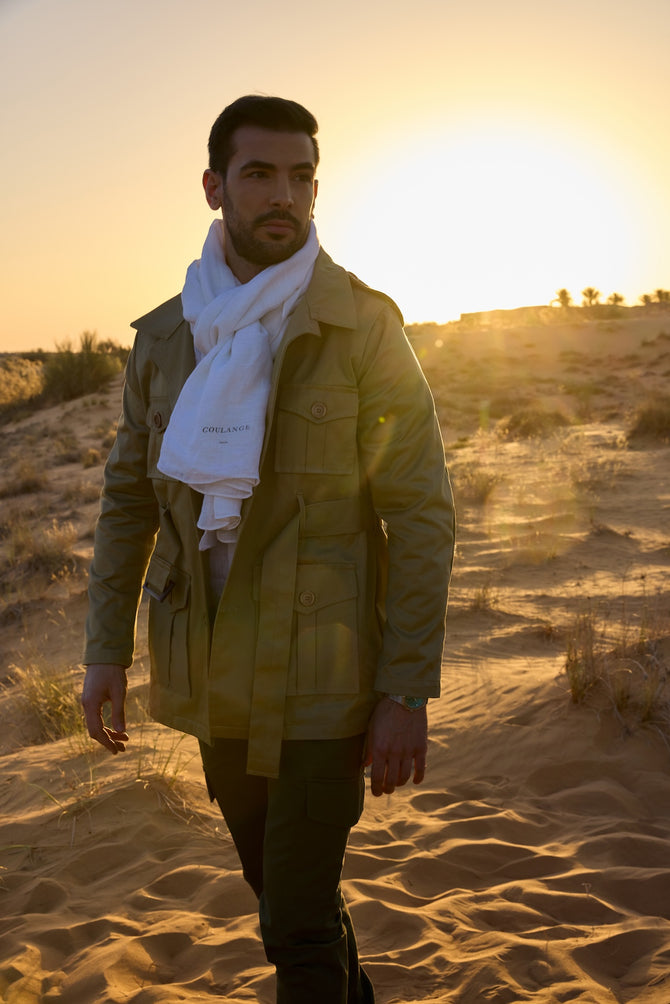
At Coulange, the safari jacket has been at the heart of our wardrobe since our origins. Crafted in our workshop in Mayenne, it is cut from superior-quality cotton, with four bellows pockets, a matching fabric belt, corozo buttons, and bound seams. Our Coulange Safari Jacket embodies this philosophy of the chic adventurer: a piece you throw on over a summer dress to go out to dinner, over jeans to explore a foreign city, or over a linen skirt for a seaside lunch. It is made to live, age, and accompany — season after season — the women who love elegance with a history.
FAQ about the women's safari jacket
Can the safari jacket be worn all year round?
Yes, provided you adapt the fabric. In lightweight cotton or linen, it is worn in spring and summer. In heavy or lined cotton, it accompanies autumn very well over a fine knit. In winter, it is kept rather indoors or under a warmer coat.
What size to choose for a safari jacket?
Favour your usual size: the cut is designed to be fitted at the waist thanks to the belt, but must remain fluid at the shoulders and sleeves. Avoid going too large: without a defined belt, the safari jacket loses all its allure.
Is the safari jacket suitable for the office?
Absolutely, provided you choose a clean cut and a sober colour (deep khaki, black, navy). Paired with tailored trousers or a pencil skirt and a white shirt, it brings a touch of different elegance, more distinctive than a classic blazer.
Safari jacket in linen or cotton: which to choose?
Tightly woven cotton offers better structure and a more defined silhouette — it is the historical fabric. Linen (or a linen-cotton blend) gives a lighter, more fluid safari jacket, ideal for hot climates but one that creases more. For a single piece that lasts and holds its cut well, favour cotton.
How to prevent the safari jacket from losing its shape at the shoulders?
Never hang it on a thin hanger or a hook: use a wide, structured hanger that follows the shoulder line. Wash at low temperature, dry flat or in the open air, and avoid the dryer — the number one enemy of natural fibres.
Discover our women's safari jacket collection in our collection.