

Women's linen dress: the complete guide to choosing and wearing it
La robe en lin femme est, chaque été, la pièce la plus convoitée du vestiaire — et l'une des plus délicates à choisir. Trop transparente, trop large, trop froissée, mal taillée, elle peut autant flatter qu'elle peut trahir une silhouette. However, when correctly selected, it becomes the epitome of summer elegance: a piece that endures the highest temperatures without becoming heavy, that goes from a terrace to a seaside dinner without changing register, and that takes on a beautiful patina throughout the summers. This guide covers everything a demanding woman needs to know to integrate linen dresses into her wardrobe: from the weight of the fabric to the choice of cut, including the colors that really flatter, the combinations that work and the maintenance that extends the piece from year to year.
Pourquoi la robe en lin reste la pièce maîtresse de l'été féminin
Linen is, among all natural fibers, the one that offers the best thermal comfort in hot weather. Its hollow tubular structure allows air to circulate freely between the skin and the fabric, absorbs up to 20% of its weight in moisture without appearing wet, and returns this moisture to the surrounding air to produce a natural cooling effect. Neither cotton, nor viscose, nor modern synthetic fibers really reproduce this feeling.
Beyond comfort, women's linen dresses have an advantage that few materials share: a dry, almost sculptural fit, which structures the silhouette without molding it. Sur une coupe bien pensée, le lin tient la ligne ; it doesn't sag, it draws. C'est précisément cette qualité qui distingue la robe en lin d'un caftan en viscose ou d'une robe en coton léger. This is also what makes it a piece deeply anchored in European textile know-how: France and Belgium together produce almost three quarters of the world's linen, and the best manufacturing workshops are still located a few kilometers from the fields.
Recognizing a quality linen dress: the six essential criteria
The composition. Aim for pure linen (100%) for maximum breathability and a characteristic drape, or a predominantly linen blend (70/30 linen-cotton for example) for reduced creasing. Beware of “linen look”, “touch of linen” labels or predominantly viscose and polyester blends: they offer neither the freshness nor the longevity of the real fiber.
The weight. This is the criterion most often neglected on a dress. Un lin trop léger (en dessous de 130 g/m²) sera transparent et perdra rapidement sa tenue. Visez un grammage entre 160 et 220 g/m² pour une robe d'été : c'est l'équilibre idéal entre fluidité, structure et opacité. On more structured models — belted dresses, safari dresses, pleated dresses — a higher weight (220-260 g/m²) guarantees an impeccable fit.
Weaving. Hold the fabric up to the light: good linen has a regular, dense grain, without coarse knots or spinning threads. Un tissage trop lâche annonce des accrocs précoces et une transparence inacceptable ; a weave that is too tight loses the characteristic freshness of the fiber.
The finishes. Examine the seams on the inside of the garment: even topstitching, folded or French seams, neat hem, clean waistband lining. Les boutons doivent être cousus, jamais collés. On a belted dress, check the quality of the central loop and the fit of the buckle: these are the first points of weakness of lower quality models.
La doublure. Sur une robe en lin clair, une doublure en coton fin ou en bemberg est souvent indispensable pour éviter toute transparence. The best houses line partially (upper body, lower to the knee) rather than completely, to preserve the breathability of the room.
The origin. A dress woven and made in Europe guarantees you not only superior quality, but also real traceability from the field to the workshop. Italian and French confections remain today the absolute reference for dressed linen. This is the criterion that distinguishes true investment pieces from seasonal products.
Cuts that flatter every body shape
Women's linen dresses come in five main families, each adapted to a particular use and silhouette.
The shirt dress (or shirt dress). Buttoned all over the front, often belted, it is directly inspired by the utility wardrobe. It is the most universal cut: it highlights the waist without constraining it, outlines the silhouette without revealing it. It is suitable for all body types and is suitable for both a business lunch and a late afternoon by the sea.
The safari dress. Direct heir to expedition jackets, it takes up the codes of utility clothing: patch pockets, functional buttons, obi belt or sewn belt. Its clean cut structures the silhouette with mastery and embodies, better than any other, the register of the chic adventurer. It is the most distinctive piece of a summer wardrobe constructed with high standards.
The trapeze dress (or A-line dress). Tightened at the bust, flared at the bottom, it is ideal for V or H shapes who want to create a defined waist. It forgives many drape flaws and remains one of the most universally flattering cuts.
The straight dress (or column dress). Falling, unbelted, it follows the line of the body without emphasizing it. It is particularly suitable for slender silhouettes and women who prefer a vertical, more minimalist reading of the summer wardrobe.
The wrap dress. Crossed at the front and tied at the waist, it precisely adjusts comfort and naturally sculpts the silhouette. It is particularly successful for hourglass body shapes and pregnant women at the start of pregnancy, who appreciate its flexibility.
Whatever cut you choose, the length is decisive. The midi length (between the knee and the ankle) is the most elegant and versatile: it adapts to flat sandals as well as heeled sandals. The long, down to the ankle, requires a suitable silhouette and a heavy weight so as not to appear floaty. The format short, just above the knee, works better on structured cuts (saharian dress, shirt dress) than on flowing cuts.
The colors to choose for a women's linen dress
Linen is a noble material that is sufficient in itself: its most beautiful colors are those which reveal its grain and the subtlety of its drape, without overloading the silhouette.
The off-white and theivory are the signature shades of the linen dress: sunny, almost luminous, they immediately evoke the Mediterranean wardrobe and magnify tanned skin. They require sufficient weight and, most often, a lining to avoid any transparency. Theecru and the sand beige extend this palette into a warmer register, ideal for the safari-inspired wardrobe. The navy blue and the midnight blue open the linen dress to dressier occasions and work admirably with cognac or gold leather accessories. The light khaki and thesweet olive bring an expeditionary note, perfect with leather sandals and a canvas bag. Finally, the terracotta and the rust brown are the ideal colors for late summer and late-season travel.
Avoid flashy prints, strong stripes and very saturated colors: the linen dress draws its beauty from its material, never from its pattern. A woman well dressed in linen is first recognized by the accuracy of her tones and the coherence of her silhouette.
How to wear a women's linen dress: three proven silhouettes
For the day, Mediterranean version. Midi white safari dress, strappy natural leather sandals, wicker or light leather basket bag, hand-woven panama hat, tortoiseshell glasses. A thin gold chain, a simple watch with a leather strap. It is the silhouette of lunch by the sea, walks in the perched villages, and the end of the afternoon on the terrace. To go further on the summer linen register, our complete guide to women's linen pants offers useful parallel reading for putting together a cohesive summer wardrobe.
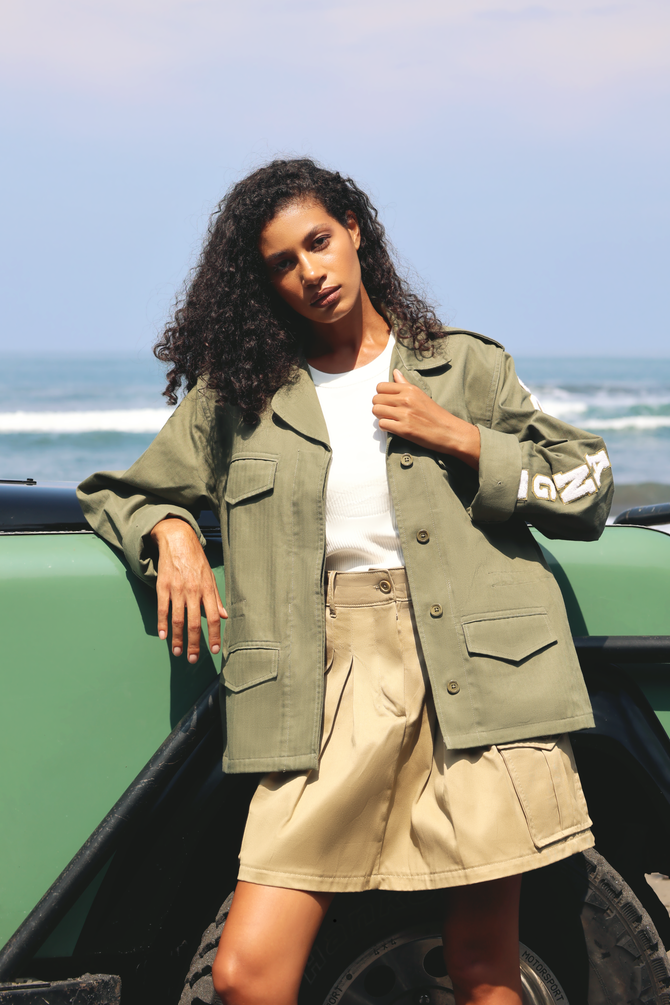
For the city, explorer version. Khaki or olive linen dress, belted at the waist, smooth leather moccasins or derbies, structured brown leather bag. A fine metal watch, a scarf tied as a headband. A safari jacket draped over the shoulders for air conditioning in offices and museums. It's a silhouette that claims the utilitarian heritage of the adventure wardrobe while remaining perfectly urban - the same consistency as that of our guide to women's safari jacket, available in a single piece.
For the evening, dressed summer version. Navy blue or ivory linen dress, fine pumps or heeled sandals, leather belt, smooth leather clutch bag. Matte lipstick, fine yellow gold jewelry. This silhouette is inspired by a Mediterranean classicism which has lost none of its modernity and which we find, extended to the entire summer wardrobe, in our guide to wearing linen jumpsuit in summer.
Linen, washed linen, mixed linen: deciphering the variants
Three names are regularly confused on labels. The classic linen offers the cleanest fit and maximum breathability; it's the go-to choice for a summer dress. The washed linen has undergone a softening treatment which makes it more supple to the touch from the first wear, at the cost of slightly more pronounced creasing; this is a great option for an everyday dress. The linen blend (linen-cotton, linen-viscose) reduces creasing and softens the drape, but reduces breathability; to be reserved for very structured dresses or mid-season pieces.
In a well-constructed summer wardrobe, the linen dress is not an isolated piece: it goes naturally with a safari jacket draped over the shoulders, a linen shirt tied at the waist, or layered over light pants for cool days. The purchasing logic is the same as for the other key pieces of the season, as illustrated by our guide to men's linen shirt : noble materials, clean cuts, natural, timeless colors.
Maintain your linen dress to keep it for ten summers
A quality linen dress requires careful but reasonable maintenance. Wash it at 30°C maximum, inside out, with a mild detergent without fabric softener - the latter weighs down the fiber and makes it lose its dry drape. Avoid tumble drying, which shrinks linen and breaks its fibers. Hang the damp dress on a padded hanger, pulling lightly at the seams and waistband to dry in shape. For very high quality, lined and structured dresses, dry cleaning remains the safest method.
To iron, iron the linen while still slightly damp, with a hot iron, using a pattemouille so as not to polish the material. If you prefer the aesthetic of naturally wrinkled linen, just iron the belt, buttons and hem: this is more than enough to preserve the line of the dress. Out of season, hang it on a shoulder hanger rather than folding it: linen marks easily when folded, and a dress stored flat will lose its structure more quickly.
The Coulange linen dress: the French elegance of the adventure wardrobe
At Coulange, the linen dress is one of the emblematic pieces of women's summer wardrobe. Our Safari Dress U53 is made in our workshop in Mayenne, cut from a 100% Italian linen canvas carefully chosen to ensure hold, opacity and freshness. Signature gold buttons, four patch pockets, belt at the waist, slightly defined shoulders: each detail is designed to structure the silhouette without constraining it. Worn alone in summer, supplemented with our Safari Jacket in mid-season, or superimposed on our Linen pants B45 for late-season travel, it creates an instantly recognizable chic explorer silhouette — sober, structured, deeply anchored in French know-how. To explore the codes of military wardrobe revisited for women, our guide to military style in summer offers additional reading useful to any woman who puts together her summer wardrobe with high standards.
Frequently Asked Questions About Women's Linen Dress
Can the linen dress be worn to the office?
Yes, as long as you choose a clean cut (shirt dress, safari dress), a sober color (navy, beige, khaki) and accompany it with structured accessories. With a jacket placed over the shoulders for air conditioning, it replaces a cool wool dress very well on hot summer days. Reserve white and ivory for more casual days or creative contexts.
Should you take your usual size for a linen dress?
Yes, in general. Linen stretches very little after washing and the cut is designed for the material. Avoid taking a size larger to gain comfort: you will lose the structure of the fit and the precision of the cut. Above all, check the length, position of the belt and shoulder width, three determining parameters for the final result.
Should a linen dress really wrinkle?
The wrinkle is one of the signatures of linen: it is what distinguishes it from synthetic fibers which imitate its appearance. Good linen creases nobly, in soft folds which largely fade after a night on the hanger. It is a signature to accept, even to claim in a clothing world too often dominated by rigidity. For a very dressy dress, a higher weight and a structured cut considerably limit visible wrinkling.
How to prevent a light linen dress from becoming transparent?
Choose a sufficient weight (at least 160 g/m² for a summer dress, 200 g/m² for a structured dress) and a tight weave. Prefer partially lined models, especially at the bust and down to the knee. In the light of the store, press the fabric against your hand: if you can clearly see the contours of your fingers, the fabric is too light for a quality dress.
What is the difference between linen dress and cotton dress for summer?
Linen offers superior breathability, a drier hang and much greater longevity than cotton, which sags more quickly and loses its color over time. Cotton remains interesting for very flexible dresses worn every day, but linen remains the reference choice for an investment piece intended to last several summers.
Discover our women's collection in our collection.