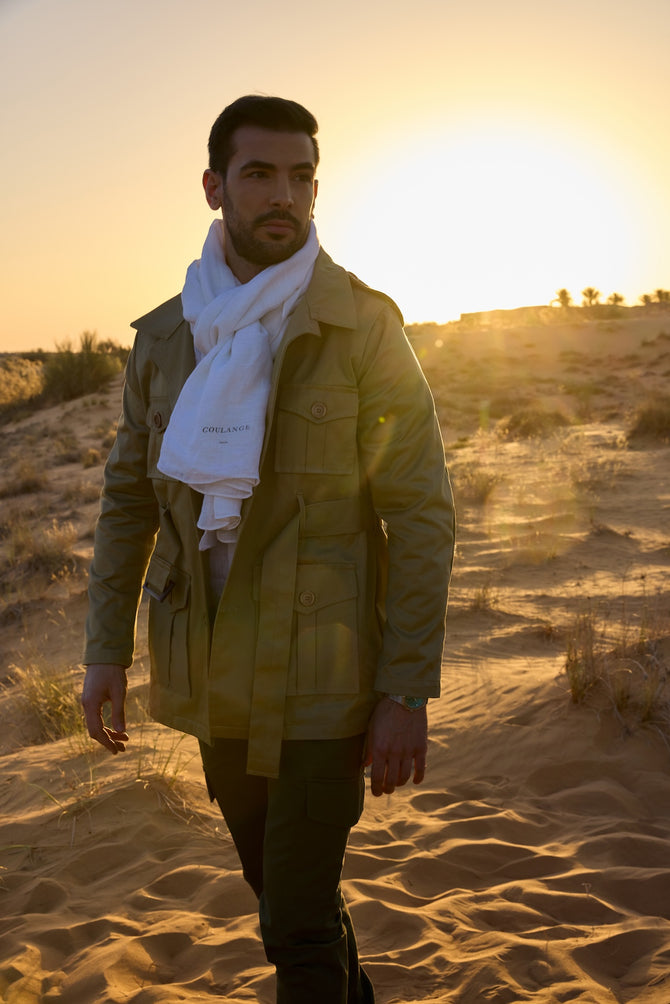
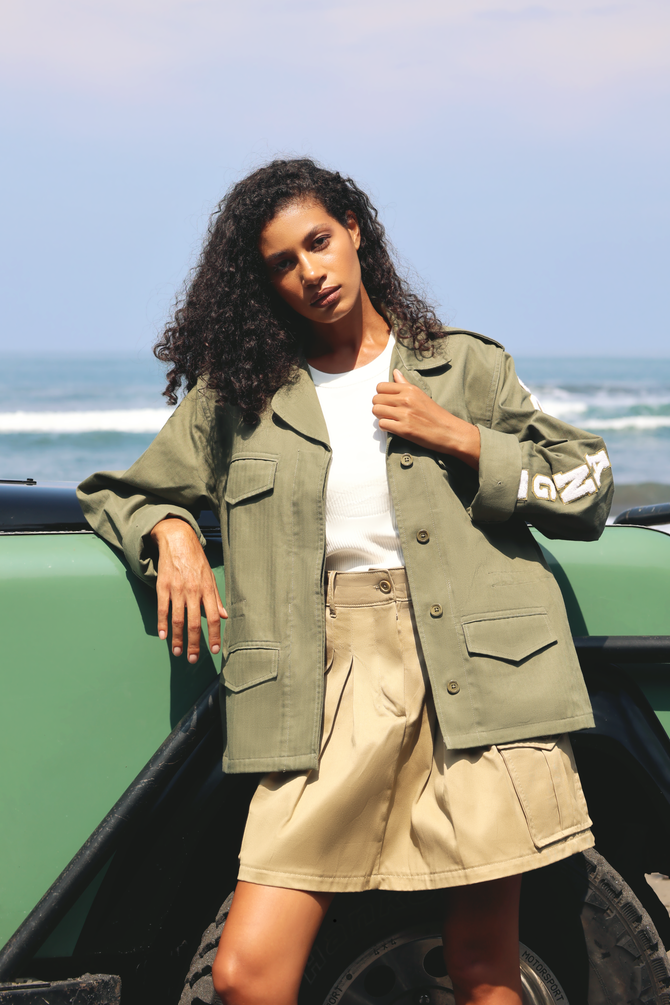


The men's mid-season jacket is undoubtedly the most difficult piece to wear in a wardrobe. Too light, it lets the April humidity seep in; too hot, it quickly becomes useless as soon as the October sun rises over Paris. Yet it is this jacket which, worn from the first breezes of April to the last cool mornings of November, defines the silhouette of a well-dressed man. At Coulange, we believe that a beautiful mid-season jacket must combine three rare virtues: a clean cut that lasts over time, noble materials (heavy cotton, merino wool, gabardine) and an adventurous look that goes just as well with raw jeans as with pleated pants. This guide brings together our guidelines for choosing the jacket that will accompany you five seasons a year, and the pieces from our French workshop that we recommend to begin this adventure.
What is a mid-season jacket for men?
The mid-season jacket is designed for transition periods, between approximately 8°C and 18°C. It is mainly worn in spring (March to May) and autumn (September to November), but the most successful also accompany cool summer evenings and the mild winters of the South. Technically, it is distinguished by an intermediate weight: neither fleece lining, nor simple linen shirt-jacket. Textile professionals speak of an envelope of 300 to 600 g/m², capable of cutting the wind without trapping heat. Visually, it falls somewhere between the short jacket and the three-quarter length coat, with a length that generally stops at the bottom of the hip or mid-thigh.
The essential cuts to know
Five archetypes dominate the men's mid-season jacket category and deserve a place in any serious wardrobe.The Harrington jacket, heritage of the Scottish greens, is probably the most versatile mid-season jacket there is. Shirt collar, ribbed cuffs, tartan pocket: it condenses everything we expect from a transitional piece. With beige chinos and loafers, it immediately creates a casual British look.
The safari jacket (or saharan jacket) draws its vocabulary from the colonial uniforms of the early 20th century. Four patch pockets, belt and shoulder pads make this a technical jacket that protects against wind and dust. In heavy cotton or thick linen, it dresses a man in town as well as when traveling.
The French work jacket, called “Bleu de Chine”, embodies a workshop style revisited in a fashion piece. Straight, short, with three patch pockets, it has established itself for ten years as a credible alternative to the casual blazer.
The officer jacket (or M-1943), with its officer collar and two flap chest pockets, provides a military verticality which structures the silhouette. It works particularly well in gabardine or light wool cloth.
The short trench coat finally, a shortened version of the classic trench coat, offers an ideal compromise for the April rain. We detail this garment in more depth in our complete guide to men's trench coats.
What material should you choose for a mid-season jacket?
The material is the first criterion for the longevity of a mid-season jacket. Three families dominate.The heavy cotton (typically 380 to 500 g/m², in twill or moleskin) protects from the wind, withstands light rain and ages beautifully by developing a patina. It is the reference choice for a safari jacket or work jacket.
The light wool (sheet, wool gabardine, summer tweed between 280 and 400 g/m²) offers superior thermoregulation to cotton: it keeps warm when it is 8°C and remains breathable at 18°C. It is particularly suitable for officer jackets and short transitional pea coats.
The thick linen, finally, is to be reserved for the end of April and September. A noble, breathable material with a unique drape, it brings a summer elegance that neither cotton nor wool can reproduce. For attentive readers, our military jackets in cotton or linen perfectly illustrate this balance.
Mid-season jacket: colors that last through the years
Three shades resist all fashions and maximize versatility: khaki green, navy blue and sand beige. Deep khaki, in particular, is the go-to color for military and safari-inspired pieces; it goes well with denim, off-white, anthracite gray. Navy blue, more urban, plays the card of preppy sobriety and matches the smooth leather shoe. Finally, beige, brighter, brings a springtime softness and recalls North African or Mediterranean palettes. For a first mid-season jacket, we recommend starting with one of these three shades rather than a seasonal color.How to wear a men's mid-season jacket in spring and fall
The golden rule is to treat the mid-season jacket as a central piece around which you build the outfit. In spring, we combine it with a chambray or linen shirt, chinos or raw jeans, and a pair of derbies or white leather sneakers. In the fall, layer a fine merino knit or a light turtleneck, then wear it over flannel or gabardine pants to maintain a sober line.
For cooler days, the layering technique makes all the difference: shirt, fine knit, mid-season jacket. The whole must remain fluid, without unnecessary thickness. Avoid thick layers under the jacket, which will make it pull at the shoulders and spoil its shape.
The Coulange piece to equip yourself this year
Our workshop in France makes several mid-season jackets designed to last. Two pieces deserve particular attention for those wishing to invest this year.
M47 Khaki green Saharan jacket is the archetype of the transitional piece. Cut from thick cotton, equipped with four patch pockets and a belt with a metal buckle, it protects from the wind and can be worn with a white t-shirt or a linen shirt. This is the jacket to slip into a travel bag: it resists creases, washes easily and gains character over the seasons.The Harrington jacket Coulange takes up the codes of the original model from the 1930s, with a quality cut and a dense fabric which make it an exceptional piece. Sober color, neat interior lining, hand finishes: it can be worn all year round as soon as the mercury drops below 18°C.
Mistakes to avoid when purchasing
Three pitfalls await the buyer in a hurry. The first is to give in to a “trendy” cut that is too fitted or too oversized; a successful mid-season jacket hugs the shoulder and leaves 2 to 3 cm of room at the chest to allow for an intermediate layer. The second is to neglect the origin: a low-cost mid-season jacket in recycled polyester will lose its hold in one season. French manufacturing, on the other hand, guarantees folded seams and durable assembly. The third is to forget about the rain: even a non-waterproof mid-season jacket should ideally have fabric treated to repel drizzle. For wetter climates, a woolen cloth peacoat can take over as soon as temperatures fall below 8°C.
Maintenance: making a mid-season jacket last ten years
A well-maintained mid-season cotton or wool jacket will keep for ten to fifteen years. Three gestures are enough. First, avoid machine washing: regular brushing (soft clothes brush) and dry cleaning once or twice per season are enough to keep it impeccable. Then, always hang it on a wooden hanger adapted to your build, never on a hook. Finally, store it away from direct light in summer, in a breathable cotton cover, with a cedar sachet to keep moths away. These gestures, inherited from traditional couture, apply to all our pieces — we find them detailed in our articles on sustainable fashion and French know-how.Frequently Asked Questions
What is the ideal temperature to wear a men's mid-season jacket?
Between 8°C and 18°C, a mid-season jacket can be worn comfortably. Above 18°C, a shirt is sufficient; below 8°C, you should consider a suitable parka, pea coat or down jacket.
What is the difference between a mid-season jacket and a jacket?
The jacket is generally shorter and sportier (Harrington, bomber, teddy). The mid-season jacket covers a wider spectrum and also includes structured cuts such as the safari jacket, the officer jacket or the work jacket.
Can you wear a mid-season jacket in the rain?
Jackets made from heavy treated cotton or wool gabardine hold up well in light rain. For sustained showers, choose a short trench coat or a waterproof piece.
What size should I choose for a mid-season jacket?
Count your usual size, checking that the shoulder falls just right (not on the arm), and that there is approximately 2 to 3 cm of room at the chest for a lightweight midlayer.Mid-season jacket or trench coat: what to choose?
The trench coat is longer and more formal. The mid-season jacket is more versatile and more relaxed. The two are complementary in a constructed wardrobe.
In summary
Choosing the right men's mid-season jacket means agreeing to invest in a piece that will be used five seasons a year for ten years. Choose a timeless cut (Harrington, safari jacket, officer jacket or work jacket), a noble material (heavy cotton, light wool or thick linen), a sober color (khaki, navy or beige) and careful tailoring. Our workshop in France offers several models from this tradition. To go further in building a sustainable locker room, explore our guide to women's raincoats, or discover all of our Coulange men’s collection.