


The Price of Clothing: A Legitimate Question
When you discover the price of a coat or jacket made in a French workshop, one question often comes up: why is it more expensive than a mass-market garment? The answer isn't in the marketing — it's in the materials, the hours of craftsmanship, and the choices of a workshop that refuse to compromise.
Since 1918, the Coulange workshop has been crafting coats and jackets in the purest French tradition. We have no factory, no assembly line, no outsourcing abroad. We have a workshop, artisans, and an obsession with quality. Here, in full transparency, is what makes up the price of a handmade garment in France.
1. The Material: The First Investment
A mass-market garment is often cut from synthetic fabric or a low-cost blend — just a few euros per meter. In a French workshop, the reality is quite different.
The cashmere we use for our coats and pea coats comes from long fibers, selected for their softness and durability. The French linen we work with for our summer jackets is grown and woven in France — a rarity that comes at a price. A water-repellent cotton gabardine, an exceptional wool cloth: every material is chosen last for years, not seasons.
For example, a meter of quality cashmere costs between 80 and 150 euros. A coat uses around 2.5 meters. The material alone already represents a significant share of the final price — before an artisan has even picked up their scissors.
2. Manufacturing Time: The Irreplaceable Hand
In a factory, a coat can be assembled in under an hour. In an artisanal workshop, the same coat requires between 8 and 15 hours of work. Each piece is cut one by one, every seam is checked, every button is sewn by hand.
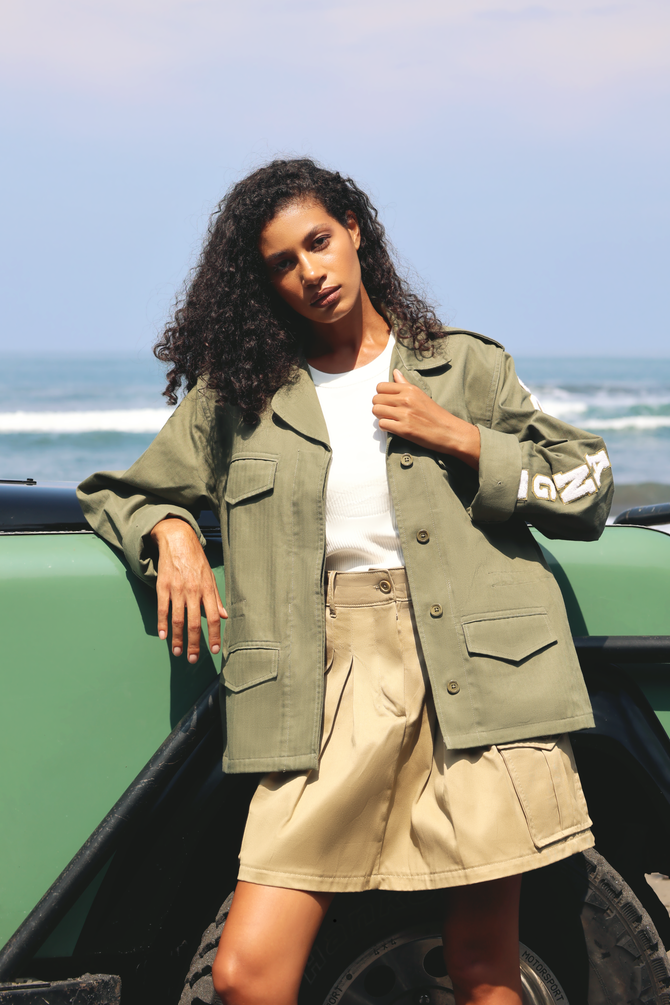
Take our M47 safari jacket, one of our signature pieces. It consists of over 40 different fabric pieces, assembled with French seams — a technique that doubles assembly time but guarantees impeccable finishing and unmatched durability. The buttonholes are hand-stitched. The pockets are lined with cotton. Every detail takes time, and that time has a cost.
A master tailor in France earns between 15 and 25 euros per hour, including social charges. For 10 hours of work, that represents 150 to 250 euros in labor per garment. This is the price of dignity — that of the artisan and that of the garment.
3. Social Charges: The French Taboo
Employing an artisan in France means bearing some of the highest social charges in Europe. For a net salary of 2,000 euros, a workshop pays around 3,500 euros — nearly double, once social contributions are added. These contributions fund Social Security, pensions, health insurance. They are the foundation of the French social model, and they weigh on the price of every piece.
When a brand outsources its production to Bangladesh or Vietnam, it avoids these charges — and pays wages that are in no way comparable. The choice to manufacture in France is a political, social, and economic choice. It has a cost. We stand by it.
4. Small Batches: The Anti-Industrial Logic
A major ready-to-wear brand produces its models by the thousands. Fixed costs — pattern development, cutting, machine setup — are diluted across immense volumes. In a workshop like ours, each model is produced in limited runs: 20, 30, sometimes 50 units.
This small scale has a direct impact on the price. Developing a unique pattern, making fit adjustments, toile trials — all of this costs the same whether there are 50 or 5,000 pieces behind it. But it also has an advantage: each garment is rare. You will never run into someone wearing the same coat.
5. Sustainability: The True Cost of “Cheap”
A 150-euro coat bought from a high-street store will last two, maybe three seasons. The seams will give way, the fabric will lose its shape, the lining will tear. It will end up in the bin, and you'll need to buy another. Over ten years, you'll have spent 600 to 750 euros on disposable coats — without ever having worn a truly beautiful piece.
A Coulange coat is designed to last twenty years, thirty years, sometimes more. We have customers who still wear their grandfather's coat, bought in the 1950s. The lining is intact, the wool cloth has developed a superb patina, the buttons still hold. Spread over the years, the price becomes remarkably low.
This is the logic of "cost per wear." A garment worn 500 times costs less than one worn 20 times, even if it was half the price to buy. Quality is the economy of the long term.
6. Short Supply Chain: A Geography of Quality
Our workshop is in France. Our fabric suppliers are French or European. Coulange favors French suppliers for its components, from haberdashery to raw materials. This short supply chain has a cost — there are fewer middlemen, but each link is paid at its fair value.
By contrast, a globalized supply chain crosses continents: cotton from India, weaving in China, manufacturing in Bangladesh, distribution in Europe. Maritime shipping costs a few cents per garment. Margins are taken from wages, not from materials. The final price is low — but the human and environmental cost is colossal.
Choosing a short supply chain means choosing to know where every component comes from. It is a premium of traceability — and it has a price.
What You're Really Buying
When you buy a handmade garment in France, you are not buying a product. You are buying:
- Noble materials, sourced with exacting standards
- Hours of artisanal work, fairly paid
- Know-how passed down since 1918
- A garment that will stand the test of time
- The independence of a workshop that answers to no group
The price of a handmade coat in France is not a luxury markup — it is a fair price. The fair price of materials, of labor, and of time. And that is perhaps the deepest reason why, for over a century, women and men have continued to entrust us with their wardrobes.
Discover our men's collection and our women's collection, entirely crafted in our French workshop since 1918.