

The women's safari dress is one of the rare pieces capable of summarizing an entire summer in a single item of clothing. Direct heir to the exploration jacket, it borrows its patch pockets, its tie belt and its shirt collar from the adventure wardrobe - but it translates them into a fluid silhouette, immediately wearable from morning to evening. It's a dress that never seeks effect: it structures without stiffening, covers without weighing it down, and goes from a shaded terrace to a dinner in town without changing its look. However, choosing the right one remains a delicate exercise. Between fabrics that are too light and sag the first time they are worn, poorly belted cuts that compress the silhouette and imitations without finishing, the mistake is common. This guide brings together everything a demanding woman needs to know before investing in a safari dress: the material, the cuts according to body type, the right colors, the ways to wear it and the maintenance that makes it last.
Why the safari dress is essential in the women's summer wardrobe
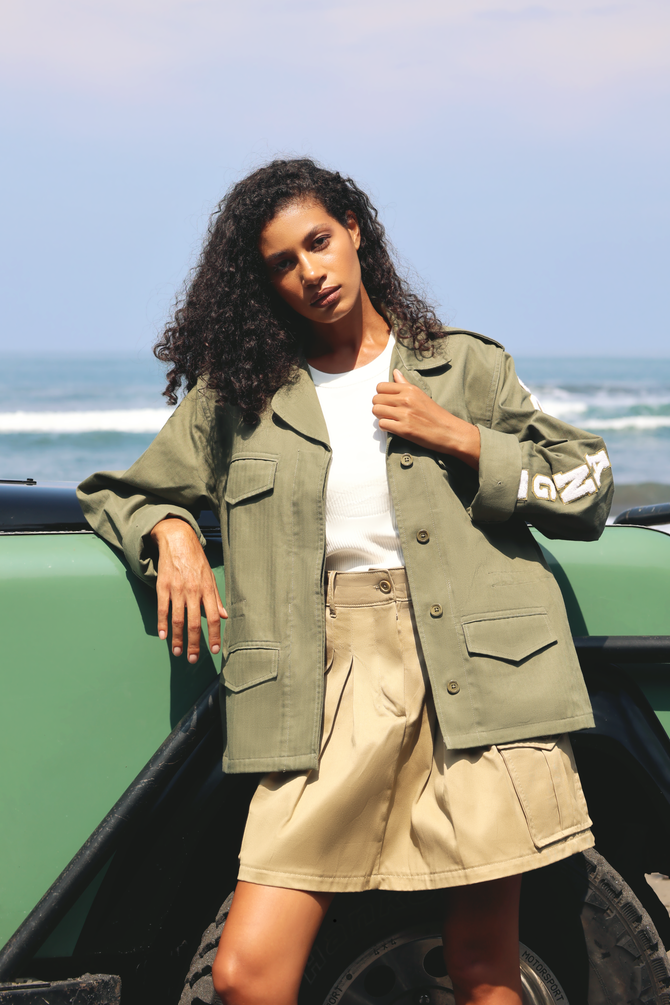
The safari jacket was born in the 1930s as functional clothing, designed for hot climates: loose, durable, with large, useful pockets. Its transposition into a dress has preserved the essentials of this heritage - the belt which marks the waist, the pockets which punctuate the silhouette, the collar which opens the neckline precisely - while gaining the fluidity of a summer piece. It is this mix that explains its lasting success: a safari dress immediately gives outfit to a summer day, where a purely flowing dress can seem casual.
Its real strength is versatility. A single safari dress covers a range of uses that no other piece equals: open over a swimsuit at the beach, belted and accessorized for a lunch, worn with sober pumps for the office, or layered over a jacket for a dinner. It travels well, creases nobly, requires no complicated matching. For a woman building a chic adventurer's wardrobe—understated, durable, designed to last several summers—this is one of the most cost-effective pieces there is.
Recognizing a quality safari dress: the essential criteria
The material. Look for natural fibers: dense, dry cotton, pure linen, or a linen-cotton blend that combines the freshness of linen and the stability of cotton. These fabrics breathe, absorb moisture and hold the cut. Avoid vague labels and low-end viscoses, which stick to the skin from the first heat and lose their hold when washed.
The weight. A safari dress should never be transparent. Below 150 g/m², the canvas becomes translucent and soft. Aim for 170 to 230 g/m²: enough body for the pockets and belt to hold their structure, enough lightness to stay comfortable in the middle of summer.
The belt. It’s the element that makes or breaks a safari dress. It must be cut from the same fabric as the dress, wide enough to mark the waist without cutting, and ideally removable via loops - which allows the dress to be worn belted or straight as desired.
Pockets and buttoning. Patch pockets must be mounted straight, at hip height, and actually usable. The central buttoning goes down to at least mid-leg: it is this which allows ease of walking and adjustment of the opening. Buttons in corozo, horn or solid metal, sewn and not glued, signify serious tailoring.
Finishes and origin. Examine the back: folded seams, even topstitching, clean facing on the collar and lapels. A dress woven and made in Europe guarantees not only superior execution but real traceability, from the yarn to the workshop — a decisive criterion for a piece that you want to keep for a long time.
Safari dress cuts that flatter every body shape
The safari dress comes in several families, each serving a particular morphology and use.
Mid-length belted shirt dress is the most versatile cut. Buttoned from the collar to the hem, tightened at the waist, it creates a clean hourglass figure and is suitable for most silhouettes — it particularly benefits O and H shapes, to which the belt gives a defined waistline.
The short safari dress, stopped above the knee, energizes the silhouette and lengthens the leg. It flatters A-shaped shapes when it remains fluid on the hips, and slender silhouettes which it punctuates without breaking.
The long or maxi safari dress plays the allure card. Slit or widely buttoned to free your step, it is slim and suitable for all sizes, as long as it is belted to avoid the tunic effect. This is the dressiest cut on the register.
The trapeze dress without belt, more flexible, glides over the body without marking it. It softens V-shaped silhouettes and offers maximum comfort on the hottest days, at the cost of less waist definition.
As a general rule, match the length of the dress to your use and your height: a short or mid-length cut for the city and everyday life, a long cut for occasions. It is the accuracy of the belt, much more than the length itself, which structures a successful silhouette.
The colors to choose for a women's safari dress
The safari dress is revealed in natural shades, those which extend its heritage of exploration and highlight the grain of the canvas rather than masking it.
The off-white, theecru and the sand beige are the signature shades: sunny, easy to combine, they immediately evoke the desert wardrobe and Mediterranean light. The light khaki and thesweet olive anchor the dress in the expeditionary register and constitute the choice with the most identity. The ink blue and the navy blue open the safari dress to more dressy and urban contexts. The terracotta, the tobacco brown and the camel bring a warmer note, ideal for the end of summer. Finally, the stone gray remains the safe bet for professional silhouettes.
Avoid very saturated shades and flashy prints: the beauty of a safari dress lies in its material and the clarity of its cut, never in its pattern. A well-dressed woman in a safari jacket is first recognized by the accuracy of her tones.
How to wear a women's safari dress: three proven silhouettes
For the day, Mediterranean version. Ecru safari dress worn belted, flat natural leather sandals, a wicker basket and some discreet gold jewelry. It is the silhouette of lunch on the terrace and the hilltop villages. To extend this summer wardrobe, our complete guide to women's linen dresses provides useful parallel reading.
For the office, urban version. Mid-length safari dress in a sober shade — navy, deep khaki or stone gray — pumps or loafers, a thin belt and a dress watch. The dress buttoned up to the collar serves as a complete outfit, without excess. To put together a coherent summer work wardrobe, rely on our guide to women's linen pants.
For the evening, adventurous chic version. Belted khaki safari dress, layered with a light jacket, heeled sandals and patinated leather accessories. This is the silhouette that fully claims the heritage of the exploration wardrobe; our article how to style a safari outfit in summer details all the codes.
Safari dress, shirt dress, trench dress: do not confuse
Three neighboring pieces often intersect under imprecise names. The shirt dress takes the collar and buttoning of a classic shirt, but without the integrated belt or the patch pockets: it is a more urban piece, less of an identity. The trench dress borrows from the coat its crossed tails, its epaulettes and its marked belt; more structured, it can be worn mid-season as a coat dress. The safari dress occupies intermediate territory: it retains the utility pockets and belt of the expedition garment, but in a summer canvas and a fluid silhouette. It’s this connection to the adventure wardrobe that sets it apart — and makes it the most relevant piece for a summer wardrobe. To understand the jacket version of this same family, our women's safari jacket guide details all the codes.
Maintain your safari dress to keep it for ten summers
A quality safari dress requires careful but reasonable maintenance. For the unlined linen or cotton versions, hand or machine wash at 30°C maximum, on a delicate cycle and without fabric softener, is ideal. Turn the dress inside out before washing to protect the buttons and color, and wash it separately the first few times.
Drying is the decisive step: hang the dress on a wide hanger as soon as the spin is finished, buttoned, so that it regains its shape as it dries — never tumble dry, which shrinks the fiber and tires the seams. Linen and cotton crease: this is their nature, and this light crease is part of the charm of the piece. A steam iron, passed over the dress while still on the hanger, is enough to restore its drape in a few minutes. Out of season, always hang the dress rather than fold it, and slip a block of cedar into a pocket to keep moths away. Properly maintained, a safari dress has a beautiful patina and is passed down - that's the whole point of investing in a real piece.
The Coulange safari dress: the French elegance of the adventure wardrobe
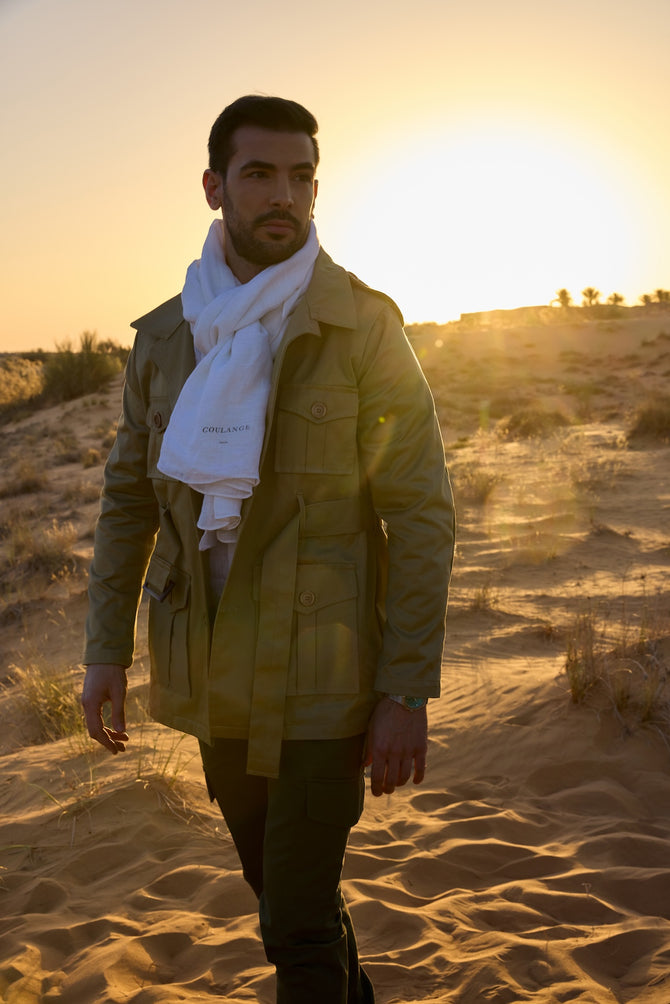
At Coulange, the safari dress embodies the spirit of the house: a chic, sober and durable adventurer's wardrobe, handmade in our workshop in France. Our Safari Dress U53 is the most accomplished expression: cut from a canvas chosen for its hold and freshness, its clean line structures the silhouette without constraining it, and its tie belt redraws the waist in a single gesture. Open range on a linen pants B45 in tunic version, superimposed on the safari jacket M47 for cooler evenings, or simply accompanied by a linen scarf C53, it creates an immediately recognizable explorer silhouette - sober, structured, deeply anchored in French know-how. Each piece is made to last and guaranteed for life: a commitment that says the essential about our relationship with clothing.
Frequently asked questions about women's safari dresses
Which safari dress to choose according to your body type?
The mid-length belted shirt dress suits most silhouettes and particularly benefits O and H shapes, to which the belt gives a defined waistline. The short cut energizes A-line silhouettes and slender body shapes. The long cut flatters all sizes, as long as it is belted. The trapeze dress without a belt softens V-shaped silhouettes. In all cases, it is the adjustment of the belt which structures the silhouette.
Does a safari dress wrinkle a lot?
Light creasing is part of the nature of natural fibers like linen and cotton: it's what distinguishes them from the synthetics that imitate them. A good fabric wrinkles nobly, in soft folds which soften after a night on the hanger. To limit visible creasing, choose a heavier weight or a linen-cotton blend, and use a steam iron over an iron.
Can you wear a safari dress to the office?
Yes, as long as you choose a clean cut - a mid-length shirt dress buttoned up to the collar - a dark color like navy, stone gray or deep khaki, and combine it with sober pumps or moccasins. Reserve very sunny ecrus and beiges for more casual contexts or weekend days.
What size should I take for a women's safari dress?
Take your usual size. The safari dress is designed to be belted, which compensates for small variations in waist size; no need to take a size larger. Check the build and chest measurement first, then the length. A dress that is too big loses the sharpness of its shoulder line, which is precisely what makes it elegant.
Linen or cotton safari dress: which one to choose?
Linen offers maximum breathability and a dry fit, ideal for hot weather, but wrinkles more. Dense cotton provides more structure and stability, and wrinkles less. A linen-cotton blend combines both qualities and is often the best compromise for a dress worn all summer, in town or when traveling.
Discover our safari dresses in our collection.