

The women's linen jacket is the piece that changes everything in a summer wardrobe. It structures a summer silhouette without ever weighing it down, takes an outfit from beachy to dressy in a single gesture, and stays fresh when all the other jackets become unbearable. However, it is also one of the most difficult pieces to choose well: between the too light fabrics which sag the first time they are worn, the poorly thought out cuts which compress the silhouette and the synthetic blends disguised as real linen, it is easy to make a mistake. This guide brings together everything a demanding woman needs to know before investing in a linen jacket - from the weight of the canvas to the choice of cut according to her body type, including the colors that really enhance the material and the maintenance that transforms a simple jacket into a transferable piece.
Why the linen jacket is essential in women's summer wardrobe
Linen is, of all natural fibers, the one that best handles high heat. Its hollow fiber allows air to circulate between the skin and the fabric, absorbs humidity without giving a feeling of dampness, then releases it to the ambient air producing a natural refreshing effect. No synthetic fiber truly mimics this behavior, and that's precisely why a linen jacket remains wearable on a hot day where a heavy cotton or gabardine jacket becomes stuffy.
But linen isn't just about comfort. Its dry, slightly structured outfit outlines the shoulders and bust line with a clarity that few summer materials offer. This is what distinguishes a linen jacket from a simple soft cardigan: it brings architecture to a summer outfit without ever making it stiff. Woven and made in Europe - France and Belgium together produce the vast majority of the world's linen - this textile also links each piece to ancient know-how, still alive a few kilometers from the fields where the plant grows.
Recognizing a quality women's linen jacket: the essential criteria
The composition. Look for pure linen (100%) for maximum breathability and characteristic drape, or a predominantly linen blend (particularly linen-cotton) to reduce wrinkling. Avoid vague labels – “linen aspect”, “touch of linen” – and compositions where low-end polyester or viscose dominate: they offer neither the freshness nor the longevity of real fiber.
The weight. This is the criterion most often forgotten. Below 170 g/m², the canvas will be soft, sometimes transparent, and will quickly lose its shape. Aim for 190 to 250 g/m² for a light summer jacket, and 250 to 320 g/m² for a more structured jacket, also wearable in mid-season.
Weaving. Hold the fabric up to the light: good linen shows a regular, dense grain, without coarse knots or pulled threads. A weave that is too loose announces early snags and annoying transparency; a very tight weave loses the freshness specific to the fiber.
Cutting and construction. On a quality jacket, the shoulder line follows the bone without falling or artificially straightening, and the lining - when it exists - remains partial, in coupro or breathable bemberg. The armholes must be clean, neither tight nor gaping: they determine the ease of movement.
The finishes. Examine the reverse: folded or French seams, buttons sewn and not glued, in corozo, real horn or solid metal. A complete facing on the lapels and straight fitted pockets are the signs of careful tailoring.
The origin. A jacket woven and made in Europe guarantees not only superior execution but also real traceability, from the field to the workshop. This is a decisive criterion for a piece that you want to keep for several summers.
Linen jacket cuts that flatter every body shape
The women's linen jacket comes in several families, each serving a particular morphology and use.
The unstructured blazer — without shoulder pads or full lining, cut close to the body but without restriction — is the most versatile cut. It elongates the silhouette, works from desk to dinner, and flatters most body shapes, especially A-line figures when it stops at hip height.
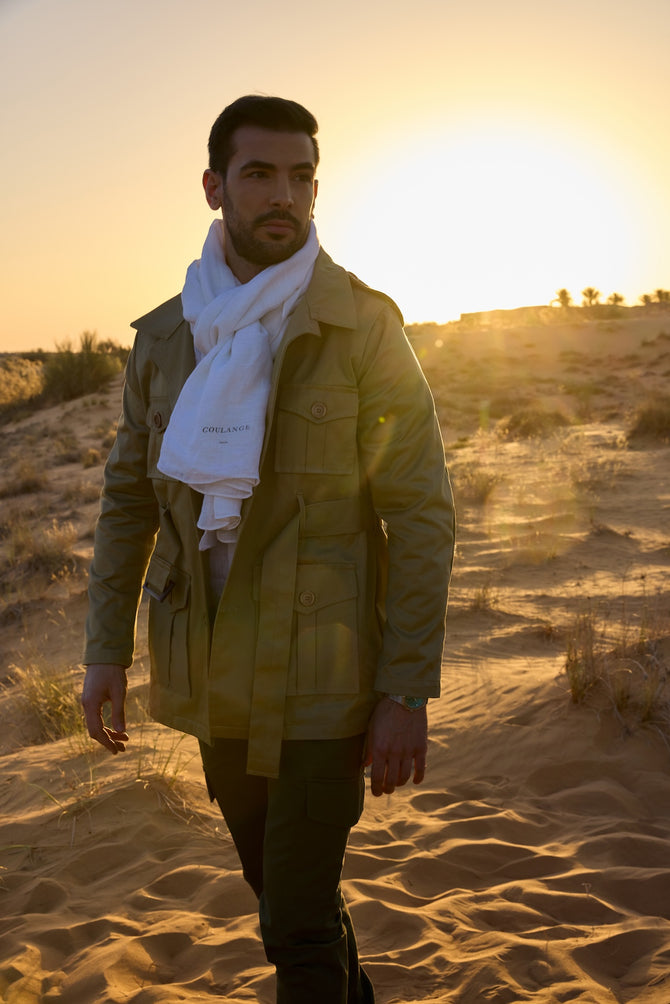
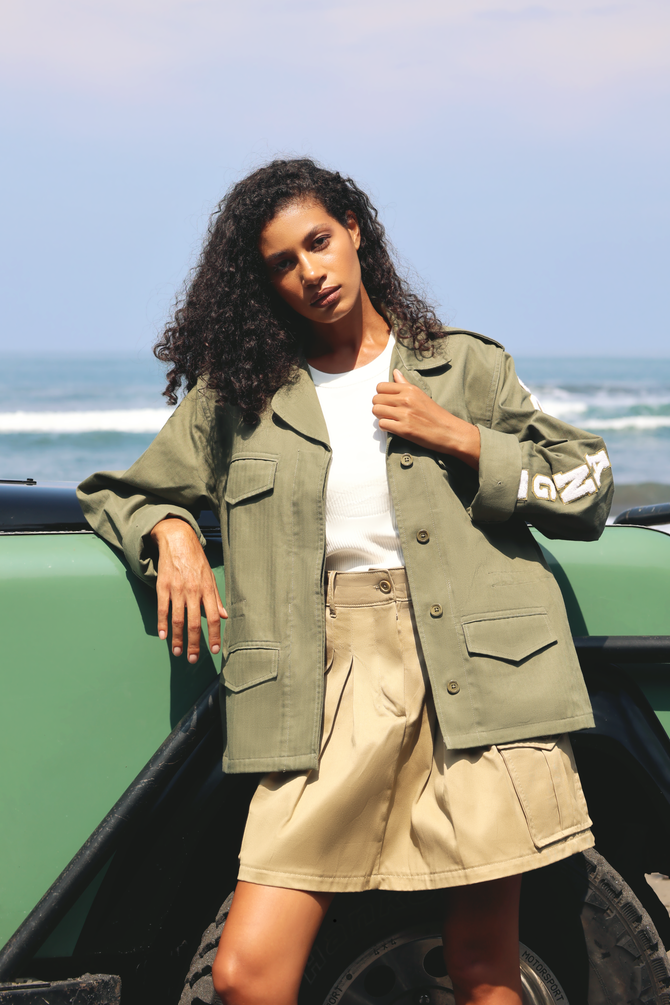
The safari jacket, heir to the expedition wardrobe, can be recognized by its patch pockets, its tie belt and its slightly marked shoulders. It's the most distinctive cut for a chic adventurer's wardrobe: the belt redraws the waist and flatters both H and O silhouettes.
The light linen bomber jacket brings a more contemporary note. Its short line and ribbing at the waist energize a silhouette, as long as you wear it over a flowing, long piece – loose pants or dress – to maintain the balance of proportions.
The collarless jacket, kimono style or tailored cardigan, is the most flexible: unstructured, it can be worn open over a summer dress and is suitable for V-shaped silhouettes, which it softens with its fluidity.
As a general rule, match the length of the jacket to the bottom piece: a cropped jacket with high-waisted pants or skirt, a mid-thigh jacket with a flowing silhouette. It is the consistency of proportions, much more than the size of the jacket itself, which structures a successful outfit.
The colors to choose for a women's linen jacket
Linen is a noble material which reveals itself in natural shades, those which highlight its grain rather than masking it.
Theecru, the off-white and the sand beige are the signature shades: sunny, easy to combine, they immediately evoke the Mediterranean wardrobe. The light khaki and thesweet olive anchor the jacket in the expeditionary register and go perfectly with ecru pants. The navy blue and the ink blue open the linen jacket to dressier occasions and are the best summer alternative to the wool blazer. The terracotta, the tobacco brown and the old pink bring a more personal note, ideal for the end of summer. Finally, the stone gray remains the safe bet in urban and professional contexts.
Avoid very saturated shades and flashy prints: the beauty of a linen jacket lies in its material, never in its pattern. A woman well dressed in linen is first recognized by the accuracy of her tones and the coherence of her silhouette.
How to wear a women's linen jacket: three proven silhouettes
For the day, Mediterranean version. Unstructured ecru blazer worn over a flowing linen dress, flat natural leather sandals, a wicker basket and some discreet gold jewelry. It is the silhouette of lunch on the terrace, perched villages and days of travel in the off-season. To compose the basis of this outfit, our complete guide to women's linen dresses provides useful parallel reading.
For the office, urban version. Navy or stone gray linen blazer, white blouse or fine knit tank top, high-waisted linen pants, loafers or sober pumps. A thin belt and a dress watch are enough to finish the outfit, without overloading. To choose the bottom that structures this silhouette, rely on our guide to women's linen pants.
For the evening, adventurous chic version. Khaki safari jacket belted at the waist, fine cotton t-shirt, long skirt or loose pants, heeled sandals and patinated leather accessories. This is the silhouette that fully claims the heritage of the exploration wardrobe; our guide dedicated to the women's safari jacket details all the codes.
Classic linen, washed linen, mixed linen: what to choose
Three names intersect on the labels and deserve to be distinguished. The classic linen offers the cleanest fit and maximum breathability; it's the go-to choice for a structured blazer or safari jacket. The washed linen has received a softening treatment which makes it supple from the first wear, at the cost of a little more wrinkling - perfect for a jacket worn every day or when traveling. The linen blend (linen-cotton, linen-cold wool, linen-silk) reduces creasing and softens the drape, but reduces breathability; to be reserved for the most formal jackets.
In a well-constructed summer wardrobe, the linen jacket is never an isolated piece: it interacts with a shirt, pants or dress from the same material family. It's the same purchasing logic that guides the summer men's wardrobe, as shown in our men's linen jacket guide — a useful read for couples putting together their summer wardrobe.
Maintain your linen jacket to keep it for ten summers
A quality linen jacket requires careful but reasonable maintenance. Choose dry cleaning once or twice per season rather than frequent washing: the lining, reinforcements and shoulder structure do not support the machine well. Between two cleanings, brush the jacket with a soft brush after wearing, air it on a shoulder hanger and refresh the drape with a steam iron.
For unlined jackets and the softest cuts, washing by hand or at 30°C maximum, without fabric softener, is still possible - dry flat on a terry towel, never in the dryer. Out of season, always hang the jacket on a wide hanger rather than folding it: linen gets marked when folded, and a piece stored folded loses its shape more quickly. A block of cedar slipped into a pocket will keep moths away without masking the material. Properly maintained, a linen jacket develops a beautiful patina over the summers and ends up being passed down - that's the whole point of investing in a real piece.
The Coulange linen jacket: the French elegance of the adventure wardrobe
At Coulange, the linen jacket embodies the spirit of the house: a chic, sober and durable adventurer's wardrobe, handmade in our workshop in France. Our B50 Linen Bomber Jacket is the most contemporary expression: cut from a linen canvas chosen for its hold and freshness, its clean line structures the silhouette without constraining it, and its deep blue can be worn both in town and when traveling. Associated with a linen pants B45 or open scope on the Coulange safari dress, it creates an immediately recognizable explorer silhouette - sober, structured, deeply anchored in French know-how. Each piece is made to last and guaranteed for life: a commitment that says the essential about our relationship with clothing.
Frequently Asked Questions About Women's Linen Jacket
Which linen jacket to choose according to your body type?
The unstructured blazer stopped at the hip suits most silhouettes and particularly benefits A-shaped body shapes. The belted safari jacket reshapes the waist and flatters H-shaped and O-shaped silhouettes. The short bomber jacket energizes a silhouette, provided it is worn over a long, flowing piece. The collarless, flexible jacket softens V-shaped silhouettes. In all cases, match the length of the jacket to the bottom piece to preserve the balance of proportions.
Does a women's linen jacket wrinkle a lot?
The light crease is part of the nature of linen: this is what distinguishes it from synthetic fibers that imitate it. Good linen creases nobly, in supple folds which largely soften after a night on a shoulder hanger. To limit visible creasing, choose a heavier weight or a linen blend, and use a steam iron instead of an iron.
Can you wear a linen jacket to the office?
Yes, as long as you choose a clean cut - an unstructured blazer or a sober safari jacket - a dark color like navy, stone gray or deep khaki, and combine it with dressy bottoms. Reserve very sunny ecrus and beiges for more casual contexts or weekend days.
What size should I take for a women's linen jacket?
Take your usual size. Linen relaxes very little after cleaning and the cut is designed for the material. Avoid taking a size larger to gain ease: you would lose the shoulder structure and the precision of the line. First check the shoulder, then the bust measurement, and only then the sleeve length.
Linen jacket or cotton jacket for summer: which one to choose?
Linen offers superior breathability, a drier drape and much greater longevity than cotton, which sags more quickly and fades after washing. Cotton remains of interest for very casual jackets that are washed frequently, but linen remains the go-to choice for an investment piece intended to last several summers.
Discover our linen jackets for women in our collection.