

Men's Parka: Complete Guide to Choosing and Wearing the Right One
The men's parka is undoubtedly the most strategic piece of the men's wardrobe. Born in the most extreme conditions - from the Arctic posts of the American army to the polar expeditions of the mid-20th century - it has conquered the streets of major capitals without ever denying its primary vocation: to protect those who wear it. But between the disposable models of fast fashion and pieces truly built to last, the gap is immense. This guide gives you the keys to choosing a men's parka that combines performance, noble materials and a durable look. Because investing in quality clothing also means choosing more responsible fashion — a founding principle at Coulange 1918, a French manufacture for over a century.
The history of the men's parka: from the Arctic to the urban wardrobe
The word “parka” comes from the Nenets language, a people of Western Siberia. Originally, it designates a garment made of seal or caribou skin, lined with fur, designed to survive the most hostile temperatures on the planet. It was the American army which, in the 1950s, formalized the parka as we know it with the N-3B model, intended for crews operating at temperatures below -60°C.
In the following decades, the men's parka migrated from military bases to university campuses, then to cultural scenes. London mods in the 1960s wore it over their suits to protect the fabric when traveling on scooters. This gesture, both pragmatic and stylistic, definitively anchors the parka in the civilian wardrobe. Today, she has become a pillar of gorpcore style like classic men's wardrobe.
The materials of a quality men's parka
The material is the first criterion that separates a durable men's parka from an ephemeral product. Here are the fabrics to choose for a long-lasting investment.
The waxed cotton is the historic material for premium outerwear. Waterproof, breathable and weathered over time, it develops a unique character over the years. A well-maintained waxed cotton parka lasts through the decades without fail.
The water-repellent technical cotton offers a lighter alternative. Surface treated to repel water, it retains the breathability of cotton while protecting against moderate showers. It's the ideal material for a mid-season parka that can be worn from early fall to late spring.
The boiled or felted wool gives the parka a more dressy dimension. Naturally insulating and water-repellent, wool is the choice for those who want a men's parka capable of going from the hiking trail to the restaurant without transition.
Finally, the technical mixtures (cotton-nylon, wool-polyamide) provide increased performance — resistance to abrasion, lightness, quick drying — while retaining the noble feel of natural fibers. At Coulange, we favor materials that age well, because a durable garment is one that does not end up in the trash after two seasons.
Essential cuts: finding the right silhouette
The cut of a men's parka determines comfort as much as style. Three large families stand out.
The long parka (mid-thigh to knees) is the most protective. It covers the upper legs and offers a vertical, assertive silhouette. This is the traditional cut, that of the original military models. It is particularly suitable for men of medium to large size, and goes naturally with a structured coat in a complete wardrobe.
The mid-length parka (just below the hips) is the most versatile compromise. Sufficiently covering to protect against wind and rain, it remains short enough not to hinder movement. This is the preferred cut for everyday use, from the office to a weekend stroll.
The short parka (waist to hips) borrows its compactness from the jacket. Less protective but more dynamic, it is suitable for sporty silhouettes and casual urban looks. It is easily worn layered with a wool jacket or a quilted vest.
How to wear a men's parka with elegance
The men's parka is a technical piece, but that does not mean that it must remain confined to casual outfits. Well chosen, it fits into all registers of the men's wardrobe.
In casual attire. The most natural combination: a khaki parka over a thick knit round-neck sweater, raw jeans and leather boots. The contrast between the rusticity of the parka and the finesse of the sweater creates an immediate visual balance. This is the register of the urban adventurer, the one who crosses the city as he would cross a mountain pass.
In smart casual outfit. Wear your parka over a flannel blazer, an Oxford shirt and chinos. The secret is to choose a parka in a sober color — khaki, navy or black — and a fitted cut that doesn't drown out the silhouette of the blazer underneath. This log is ideal for workdays where the weather is uncertain.
In formal attire. Mods proved it sixty years ago: a parka over a suit works. Opt for a refined model, without too many pockets or military details, in a matte and structured fabric. The Coulange Heritage Parka, with its clean cut and dense wool cloth, perfectly illustrates this approach: the useful at the service of the elegant.
Men's parka: the details that make the difference
Beyond the material and the cut, several technical details distinguish an exceptional men's parka.
The hood. This is the signature element of the parka. It must be deep enough to protect from the wind without obstructing peripheral vision. The best hoods have a drawstring system and a rigid visor that prevents rain from running down your face. A removable hood provides additional versatility.
The pockets. A functional parka has at least two side flap pockets and one interior pocket. Flap pockets protect their contents from the rain; the patch pockets add visual volume and reinforce the utilitarian character of the piece. The most advanced models include chest pockets and cargo pockets on the thighs.
The lining. The quality of the lining directly determines the thermal comfort and longevity of the garment. A lining in cotton twill, wool flannel or fur (natural or synthetic) guarantees warmth and breathability. Some parkas offer a removable lining which transforms the winter garment into a mid-season piece.
The finishes. Taped seams, YKK zipper under windproof tab, metal press studs, ventilation eyelets under the arms: these details invisible at first glance are those which, season after season, make all the difference between a garment that ages well and one that wears out.
Choosing the right color for your men's parka
The choice of color determines the versatility of your men's parka in your wardrobe.
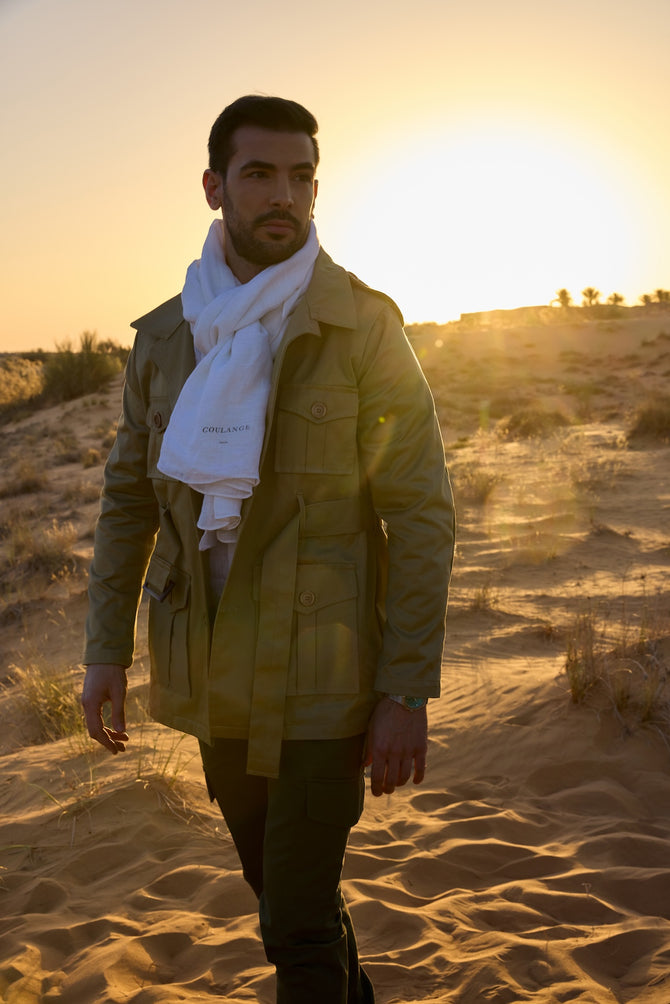
The khaki is the original and most versatile shade. It goes with almost everything — raw denim, gray flannel, beige chinos — and patinates superbly over time. It is the choice for those who want an all-purpose parka, capable of working both in the city and in the countryside.
The navy blue brings a more dressed dimension. More discreet than khaki, it fits naturally into a classic wardrobe and can be worn easily with a blue or gray suit. It is the color to favor for semi-professional use, in line with a navy peacoat or a dark trench coat.
The black gives the parka an urban and contemporary look. It suits minimalist silhouettes and monochrome looks. Be careful though: black reveals every crease, every wear, and requires impeccable fabric to remain elegant over time.
The earth tones — tobacco, camel, brown — are a refined alternative to khaki. Less common, they bring warmth to the complexion and blend perfectly with natural materials (wool, linen, leather) which characterize a sustainable wardrobe.
Maintaining your men's parka to make it last
A quality garment deserves careful maintenance. The men's parka, exposed to the elements, requires special attention to maintain its properties and its appearance.
Regular brushing is the fundamental gesture. After each wearing, brush your parka with a soft-bristled brush to remove dust and residue. This simple gesture preserves the fibers and revives the shine of the fabric.
Washing depends on the material. Technical cotton parkas can generally be machine washed at 30°C on a delicate cycle, turned inside out and closed. Wool or waxed cotton models should be taken to a specialist dry cleaner. Never put a quality parka in the dryer: the heat alters the water-repellent treatments and distorts the seams.
Storage determines the lifespan of your parka. Always store it on a wide wooden hanger, never folded in a drawer. Leave it in a ventilated place, away from direct light. If you store it for the summer, use a cotton cover (never plastic) which lets the fabric breathe.
Re-waterproofing is necessary once or twice a year for treated cotton parkas. Specific water-repellent sprays allow you to renew the protection without altering the material. Apply the product to a clean, dry fabric, then allow to air dry for 24 hours.
Why choose a men's parka made in France
In a market saturated with standardized products manufactured on the other side of the world, opting for a men's parka made in France is a thoughtful act. It is first of all the guarantee of artisanal know-how: cuts adjusted to European morphologies, manual finishing where the machine reaches its limits, demanding quality controls at each stage of production.
It is also an environmental choice. A parka made in a French workshop travels a few hundred kilometers before reaching your wardrobe, compared to thousands for an imported model. The carbon footprint is mechanically reduced. And when the garment is built to last ten years or more, the impact per year of use becomes marginal.
At Coulange, our parkas are designed and assembled in our workshop in Mayenne. Each piece — from the Heritage Parka at the M38 Military Jacket — bears the imprint of gestures passed down since 1918. It is this requirement, silent but constant, which makes the difference between a garment that we wear and a garment that we keep.
Frequently asked questions about men's parkas
What is the difference between a men's parka and a classic coat?
The men's parka is distinguished by its integrated hood, its mid-thigh to knee length and its technical properties (waterproofing, windproof). Unlike the classic coat, it is designed to face bad weather while maintaining a structured volume. High-end parkas combine this functionality with noble materials and a careful cut.
How to choose the right size men's parka?
A men's parka should allow you to layer a sweater or blazer without compressing the shoulders. Check that the shoulder seam falls exactly over the shoulder bone, that the sleeves reach the wrist, and that the zipper closes without tension. If you are unsure between two sizes, choose the larger size for layering comfort.
How to maintain a men's waxed cotton parka?
Waxed cotton is not machine washable. Wipe stains with a damp cloth and mild soap. Re-impregnate the fabric once per season with a suitable wax to maintain waterproofing. Store the parka on a wide hanger in a ventilated place, never in a plastic cover which prevents the material from breathing.
Can you wear a men's parka to the office?
Absolutely. A men's parka in technical cotton or water-repellent wool, in a sober color such as khaki, navy or black, fits perfectly into a professional wardrobe. Worn over a suit or pleated pants with a shirt, it brings a touch of confidence without compromising elegance.
What color men's parka is the most versatile?
Khaki remains the most versatile shade for a men's parka. It goes just as well with raw jeans as with gray suit pants. Navy blue comes in second for its ability to fit into a formal wardrobe. Black suits urban and minimalist silhouettes.
Discover our parkas for men in our collection.