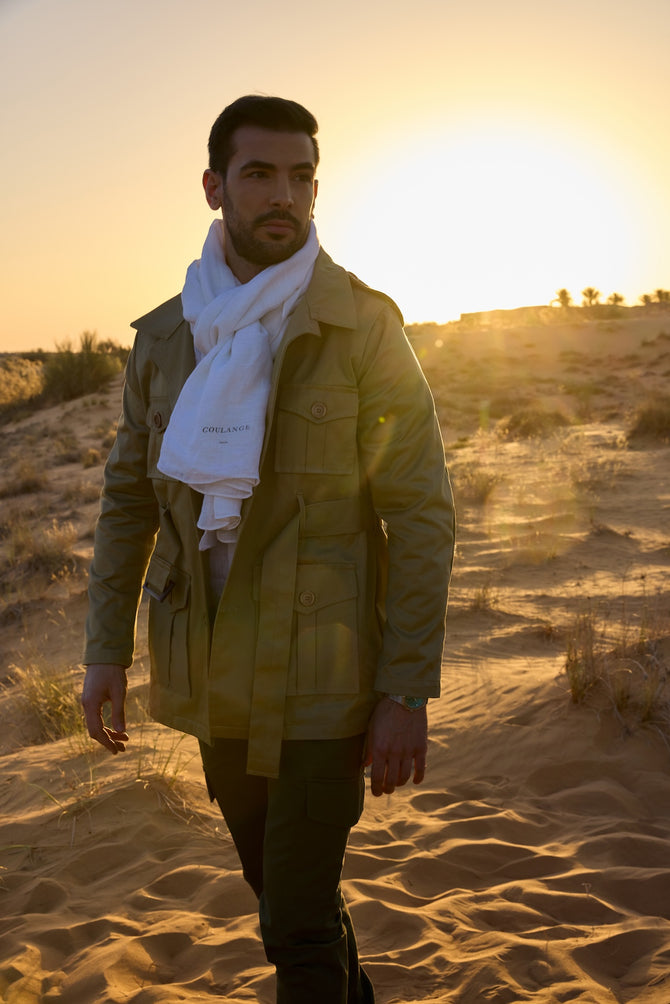
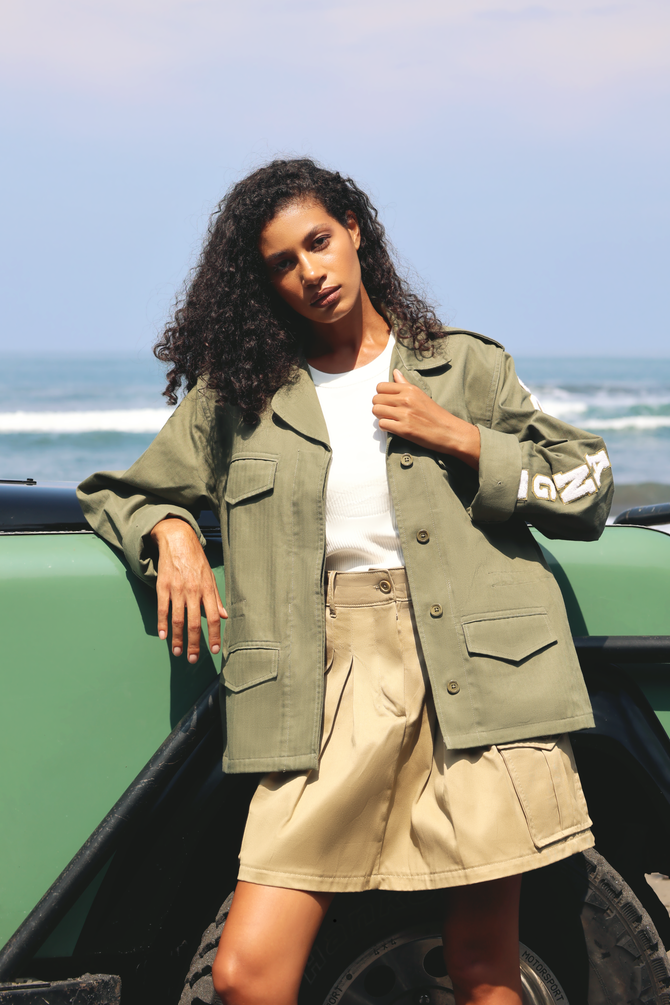


The safari jacket is one of those rare pieces that spans the ages without ever going out of fashion. Born in colonial outfits, adopted by Yves Saint Laurent, reinterpreted by each fashion house, it embodies a subtle balance between elegance and functionality. But how do you choose the safari jacket that really suits you? Between materials, cuts and uses, here is the complete guide to making the right choice — and wearing this piece with the ease it deserves.
The origins of the safari jacket
Before entering the women's wardrobe, the safari jacket was a military outfit, designed for hot climates and long journeys. Its grid structure, four bellows pockets and knotted belt made it a utilitarian garment.
In the 1970s, Yves Saint Laurent elevated it to the rank of icon. Since then, each house that has acquired it has brought its own interpretation to it: some make it an urban piece, others a manifesto of relaxed elegance. At Coulange 1918, the safari jacket is treated like a summer coat — an architectural piece, where each seam tells a gesture.
Why the safari jacket is essential
The safari jacket occupies a special place in a wardrobe. Neither quite a jacket, nor really a trench coat, it slides with ease from the city to the first summer evenings. It's a piece that can be worn open over a blouse, belted over a dress, or simply thrown over the shoulders when the breeze picks up.
What makes the safari jacket so special is its ability to structure a silhouette without weighing it down. A beautiful safari jacket reshapes the waist, lengthens the line, and brings that touch of measured elegance which distinguishes an accomplished outfit from a simple assembly.
Materials: the choice that changes everything
French linen
For sunny days, linen is unrivaled. A linen safari jacket breathes, develops a patina over time, and gains character with each season. The fiber, grown and woven in the great tradition, offers this slightly wrinkled texture which gives all the charm to living clothing.
The Linen safari jacket U51 of the House illustrates this approach: a refined cut, a linen of mineral whiteness, and this texture which never fades. A piece that you wear in summer like you would wear a coat in winter — with naturalness.
Long fiber cotton
More structured than linen, cotton gives the safari jacket an impeccable fit. It is the choice of those who like the clarity of a shoulder and the precision of a marked waist. A well-chosen cotton, dense to the touch, will last through the seasons without weakening.
Cashmere and exceptional fabrics
Some safari jackets are available in more precious fabrics - a light cashmere for mid-season, a woolen cloth for fall. These hybrid pieces blur the line between the jacket and the coat, and stand out as essential wardrobe investments.
How to choose the cut that suits you
The straight cut
It's the most classic, the one that goes down to mid-thigh without bending. It suits all silhouettes and can be worn both open and belted. If you're hesitant, start there — a well-proportioned straight cut never disappoints.
The fitted cut
Marked at the waist, it outlines the silhouette with confident elegance. This is the cut we choose when we want the safari jacket to play the role of a strong piece, capable of carrying an outfit on its own. Wear it over a flowing dress, and let the line do the rest.
The safari dress
The safari jacket doesn't stop at the jacket. In a dress version, like the Safari Dress U53, it becomes a piece in its own right, which can be worn from morning to evening with a simple change of accessories. A well-cut safari dress advantageously replaces the classic summer dress while bringing that touch of discreet refinement.
Manufacturing details
An exceptional safari jacket can be recognized by its details. The buttons, first – neither too discreet nor too conspicuous. The belt, which must have the right weight — enough body to tie well, enough flexibility not to constrain. The stitching, which stabilizes the pockets without stiffening them. And then this general pattern, this way that clothing follows the movement without ever preceding it.
These details are the result of know-how where every gesture counts. A well-made safari jacket doesn't just look good in the store — it stays that way, wash after wash, season after season.
How to take care of your safari jacket
Quality linen and cotton patina gracefully, but they require some attention. Wash cold, air dry — never tumble dry — and lightly iron, inside out, for linen. Cashmere is sent to a specialized dry cleaner.
A carefully maintained safari jacket lasts through the years. It's a piece of clothing that gets better, like beautiful leather or a mechanical watch. The first season, we tame it. The third is part of oneself.
How to wear the safari jacket
The safari jacket lends itself to all variations. With white jeans and flat sandals, it is the embodiment of casual chic. On a silk dress, it brings a welcome touch of structure. Worn open over a linen tank top, it becomes the centerpiece of an effortless summer outfit.
For the evenings, dare to wear a belted safari jacket over flowing pants. The whole creates a slender silhouette, both assertive and feminine. And for those who like contrast, a raw linen safari jacket over a pleated skirt brings that elegant friction that makes the most beautiful outfits.
Discover our complete collection of safari jackets for women and find the one waiting for you.
The safari jacket is not a purchase — it’s an encounter. Take the time to try, to compare the materials, to feel the feel. Once you find yours, you will never leave it.