

Women's Trench Coat: The Complete Guide to Choosing and Wearing It
The women's trench coat is one of those rare pieces that transcends fashion without ever going out of style. Born in the trenches and later adopted by explorers, travellers and women of character, it has retained from its military history a crisp silhouette: epaulettes, double-breasted front, waist-cinching belt, panels that billow in the wind. It is a coat that structures an entire look in an instant — thrown over a summer dress or buttoned up over a winter jumper. Yet choosing the right one remains a demanding exercise. Between synthetic gabardines that shine and crease poorly, ill-belted cuts that squash the silhouette, and lengths unsuited to one's body shape, mistakes are common. This guide brings together everything a discerning woman needs to know before investing in a trench: fabric, cuts by body type, the right colours, how to wear it in every season, and the care that keeps it going for years.
Why the trench coat remains the hardest-working piece in a woman's wardrobe
The trench was born of a function: to protect from rain and wind without restricting movement. From this utilitarian origin it has retained everything that today defines its elegance — the cuff-tightening straps, the back martingale, the storm flap on the shoulder, the belt that ties rather than buckles. Each of these details had a purpose before becoming a style code, and it is precisely this honesty of design that sets a true trench apart from a coat that merely borrows its shape.
Its strength lies in its breadth of use. A single well-chosen trench covers an entire mid-season wardrobe: worn open and tied at the back over a summer outfit, closed over knitwear in autumn, over a suit at the office or with jeans at the weekend. It travels beautifully, demands no complicated matching and ages gracefully. For a woman building an adventurer's wardrobe — understated, enduring, designed to last for years — it is the safest investment there is.
How to recognise a quality trench coat: the essential criteria
Fabric. The classic trench is cut from a tightly woven cotton gabardine, ideally water-repellent, that sheds rain while letting the fibre breathe. Look for a dense cotton with a dry hand, possibly rain-treated, or a cotton blend with a small proportion of technical fibres for hold. Avoid shiny polyesters and cheap synthetic linings, which cling, overheat and betray unambitious construction.
Weight and drape. A good trench has body without being stiff: the cloth should hang straight, hold the martingale's fold and keep the shoulder structure. A gabardine that is too light will collapse and make the coat look sloppy; a cloth that is too heavy loses the fluidity that gives the trench its charm. The sweet spot is in the hang — on a hanger, a quality trench keeps its line.
The belt. This is the element that makes or breaks a trench. It must be cut from the same fabric as the coat, wide enough to define the waist without cutting in, and slide through sturdy loops. Most women tie it at the back rather than buckling it at the front — a gesture that refines the silhouette and frees the panels.
Construction details. Check for the authentic codes: double-breasted front, storm flap, cuff-tightening straps, back martingale, vent at the hem. Buttons in corozo or solid metal, sewn — never glued — even topstitching, and a collar that stands up neatly all signal serious craftsmanship.
Finishing and provenance. Examine the inside: flat-felled seams, clean facing on the collar and lapels, a lining mounted flat. A trench woven and made in Europe guarantees superior execution and genuine traceability, from thread to workshop — a decisive criterion for a piece you want to keep for a long time.
Trench cuts that flatter every body type
The trench comes in several families, each serving a particular body shape and purpose.
The belted mid-length trench, stopping at or just above the knee, is the most versatile cut. Belted, it draws a clean hourglass and suits most silhouettes — it particularly favours apple and rectangle shapes, for whom the belt restores a defined waist.
The long trench, falling below the knee or even to the calf, plays the elegance card. It elongates the silhouette and suits all heights provided it is belted to avoid the floating-coat effect. It is the most dressed-up and protective cut in the range.
The oversized trench, worn loose and often open, softens the silhouette and lends itself to winter layering. It flatters leaner frames, which it punctuates without breaking, and requires smaller women to belt it to avoid being swamped.
The cape-style trench with full panels, more fluid, glides over the body without marking it. It softens inverted-triangle shapes and offers maximum freedom of movement, at the cost of less waist definition. As a general rule, match the trench length to your height: a mid-length cut for petite frames, a long cut to elongate. It is the rightness of the belt, far more than the length, that structures a successful silhouette.
Which colours to choose for a women's trench coat
The trench reveals itself in natural tones — those that extend its heritage and cross the seasons without dating.
Sandy beige and camel are the signature shades: luminous, timeless, they pair with the entire wardrobe and instantly evoke the classic trench. Khaki and olive anchor the coat in military and expeditionary territory — the most characterful choice for an adventurer's wardrobe. Navy blue opens the trench to urban and formal settings and offers a more understated alternative to beige. Stone grey remains the safe bet for professional silhouettes, while black lends a sharper, more city-focused note.
Avoid highly saturated hues and high-shine finishes: the beauty of a trench lies in the matte quality of its cloth and the crispness of its cut, never in a colour effect. A well-dressed woman in a trench is recognised first by the rightness of her tones.
How to wear a women's trench coat: three proven silhouettes
Mid-season, classic version. A beige trench worn open and tied at the back over a fine knit, straight trousers and derbies or ankle boots in natural leather. This is the timeless spring and autumn silhouette — the one that never disappoints.
For the office, urban version. A trench in a sober shade — navy, deep khaki or stone grey — closed over a trouser suit or shirt dress, court shoes or loafers, a structured bag. The trench acts as the centrepiece without any overload. To build a coherent summer work wardrobe underneath, refer to our guide to the women's linen jacket.
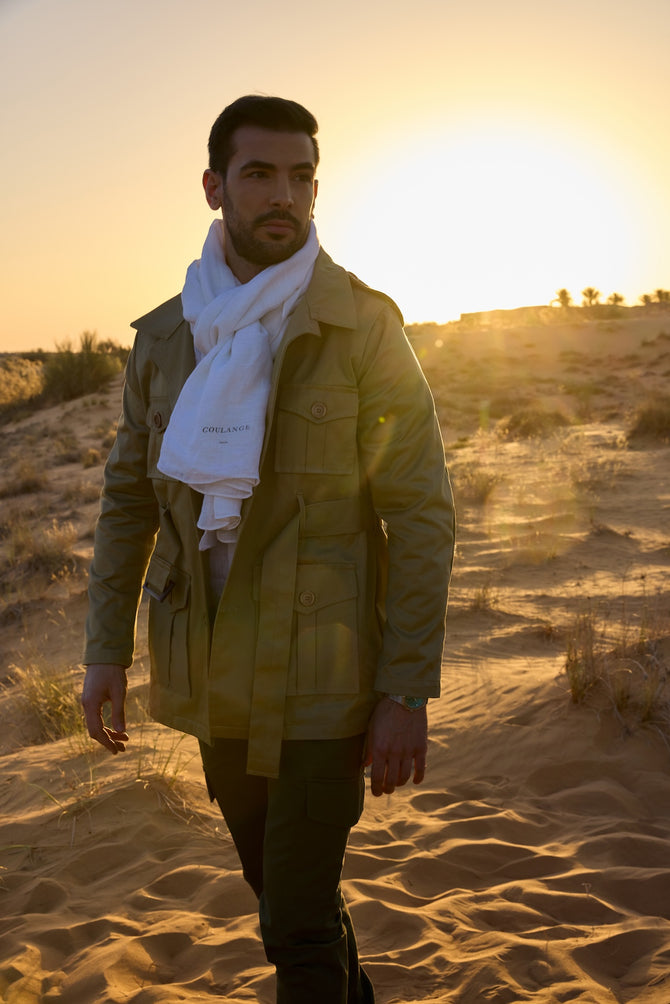
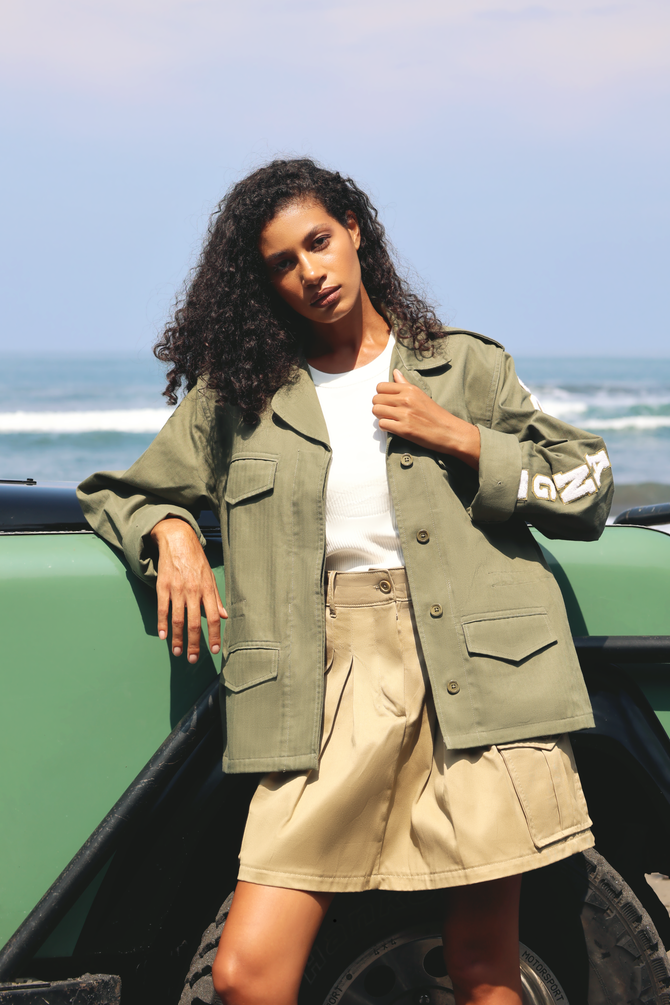
For travel, chic adventurer version. A belted khaki or olive trench, worn over a safari jacket and utility trousers, with patinated leather accessories and a shemagh knotted at the neck. This is the silhouette that fully claims the heritage of the exploration wardrobe; our guide to the women's safari jacket details all its complementary codes.
Trench, raincoat and pea coat: don't confuse them
Three neighbouring coats are often conflated under imprecise labels. The raincoat designates first and foremost a function — repelling water — without imposing a silhouette: it may be short, straight, hooded, without any of the trench's codes. The pea coat, inherited from the navy, is shorter, double-breasted, cut from a thick wool cloth: it is a structured winter coat, alien to the gabardine register. The trench occupies a precise territory: a water-repellent gabardine, a double-breasted front, a tied belt and a mid-length to long silhouette inherited from military garments. It is this lineage to the expeditionary wardrobe, more than the rain protection alone, that sets it apart — and that makes it the most relevant piece for a mid-season wardrobe.
Caring for your trench to keep it for ten years
A quality trench demands careful but reasonable maintenance. For water-repellent cotton gabardines, favour occasional dry cleaning over frequent washes, which degrade the water-repellent treatment; between cleanings, a soft brush and a damp sponge are enough to revive the cloth. If the label permits washing, choose a delicate cycle at 30 °C maximum, no fabric softener, and fasten the buttons to protect the structure.
Drying is the decisive step: hang the trench on a wide, sturdy hanger as soon as the spin cycle finishes — never tumble-dry, which shrinks the fibre and strains the seams. Gabardine creases little, but a garment steamer, passed over the coat while still on its hanger, restores its drape in minutes. Out of season, always hang the trench rather than folding it, in a cotton cover that lets the fibre breathe, and slip a cedar block into a pocket to deter moths. To go deeper into natural fibre care, our linen and cotton care guide details the right techniques. Well cared for, a trench acquires a beautiful patina and gets passed on — that is the whole point of investing in a genuine piece.
The Coulange trench: French elegance from the adventurer's wardrobe
At Coulange, the trench embodies the spirit of the house: an adventurer's wardrobe — chic, understated and enduring, handcrafted in our workshop in France. Our Trench coat khaki green M67 is its most faithful expression: cut from a gabardine chosen for its hold and rain resistance, it brings together all the authentic codes — double-breasted front, tied belt, back martingale — in a crisp line that structures the silhouette without constraining it. For women seeking a longer, more enveloping piece, our long water-repellent cape trench coat C61 combines the elegance of the trench with the fluidity of the cape, ideal for travel and unpredictable mid-seasons. Worn open over a linen shemagh C53 knotted at the neck, it creates an instantly recognisable explorer's silhouette — understated, structured, deeply rooted in French craftsmanship. Every piece is made to last and guaranteed for life: a commitment that says everything about our relationship with clothing.
FAQ: women's trench coat
Which trench coat should I choose for my body type?
The belted mid-length trench suits most silhouettes and is especially flattering for apple and rectangle shapes, for whom the belt restores a defined waist. The long cut elongates all heights, provided it is belted. The oversized trench flatters leaner frames and needs smaller women to belt it. In all cases, it is the belt adjustment, tied at the back, that structures the silhouette.
Can you wear a trench in summer?
Yes. A trench in lightweight, water-repellent gabardine is ideal for cool evenings, windy days and summer showers. Worn open over a linen dress or a summer outfit, tied at the back, it brings structure without heat. It is precisely this seasonal versatility that makes it the hardest-working piece in any wardrobe.
Which trench colour is the most timeless?
Sandy beige and camel are the most classic shades and the easiest to pair: they cross the seasons without dating and match the entire wardrobe. For a more characterful, adventurous look, khaki and olive are excellent alternatives. Navy and stone grey suit professional silhouettes.
What size trench coat should a woman take?
Take your usual size, allowing for the layers you will wear underneath. The trench is belted, which compensates for minor waist variations; there is no need to size up unless you are deliberately seeking an oversized look. Check the shoulder fit and sleeve length first — they define the crispness of the shoulder line.
Cotton trench or technical gabardine: which to choose?
A tightly woven cotton gabardine offers the matte elegance and natural hand of the classic trench, with decent water repellency if treated. A cotton blended with technical fibres gains in rain resistance and hold, at the cost of a slightly less noble feel. For a piece worn throughout the mid-season, a water-repellent cotton gabardine often offers the best balance of elegance and function.