

Choosing made in France is not simply about affixing a flag to a label. It is about defending a demanding production model, rooted in a territory, carried by artisans whose gestures are passed down from generation to generation. At Coulange, this conviction is not a marketing argument. It is the very foundation of the house since 1918.
At a time when fast fashion standardizes wardrobes and offshores production, certain French houses make the opposite choice: that of proximity, traceability, and durability. Coulange is one of them. This article revisits the roots of this commitment, what it concretely means to manufacture in France today, and the natural place the house occupies within the made in France ecosystem.
A House Rooted in Mayenne for Over a Century
The story of Coulange begins in 1918, in the heart of Mayenne, when the Coulange family took over a textile factory and founded the house of the same name. From its earliest years, the workshop distinguished itself through the tailoring of pieces intended for the French Navy: deck jackets, overalls, and coats designed to withstand the harshest conditions at sea. For nearly fifty years, French sailors wore these garments, shaped to resist violent winds and sea spray.
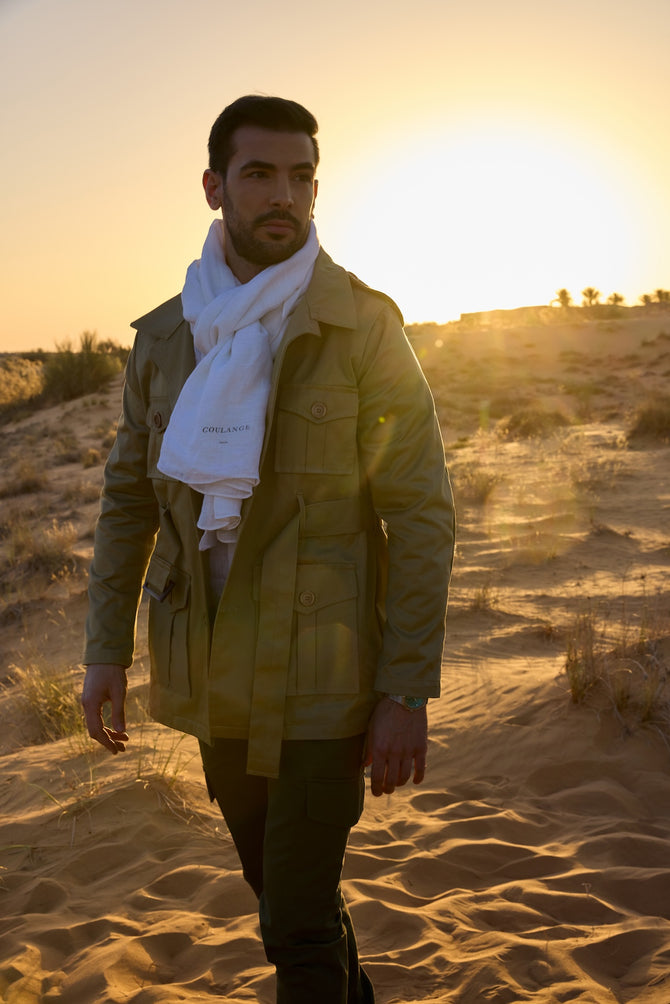
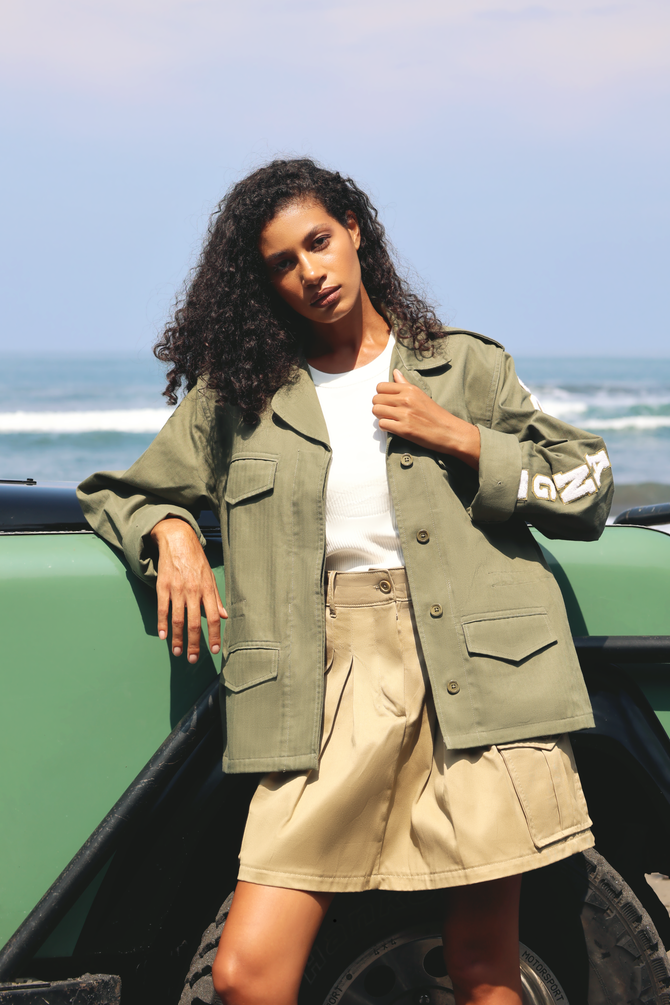
In parallel, the army called upon Coulange for its safari jackets, cut for exploration and extreme climates. The cuts were inspired by officers' field uniforms, combining freedom of movement and absolute robustness. This dual heritage — maritime and terrestrial — constitutes the house's DNA. It is found today in every piece of the collection, whether a parka, has military jacket, or a revisited trench coat.
→ Read also: Our Story — Coulange's Craftsmanship Since 1918
What “Made in France” Means at Coulange
The "made in France" label covers very different realities. Some brands only carry out final assembly in France of elements produced elsewhere. At Coulange, the approach is radically different: the house masters the entirety of its production chain, from the selection of raw materials to the finishing of each piece.
Two Workshops, One Level of Excellence
Coulange jackets, coats, safari jackets, and parkas are handcrafted in two workshops located in France: one in Mayenne and the other in Aube. Both sites operate according to the codes of high-end craftsmanship: every seam is checked, every detail is inspected, every piece comes with a lifetime guarantee.
Traceable and Responsible Materials
Coulange works exclusively with fabrics whose origin is identified. The water-repellent cotton used for the Heritage Parka, for example, is made in France. The recycled synthetic fur linings reflect a desire to combine warmth, durability, and environmental responsibility. The linen, wool, and cashmere that make up certain pieces in the collection are selected with the same rigor.
Craftsmanship as a Philosophy
Manufacturing in France is not just a geographical question. It is a choice that implies a vision: that of a garment designed to last, cut to be worn for years, not replaced at the rhythm of the seasons. The house's motto summarizes this philosophy: "Handmade, built to last." Each Coulange jacket is designed as a wearable heirloom, a piece to be passed down.
→ Discover the men's collection — Parkas, safari jackets, and military jackets
→ Discover the women's collection — Capes, trench coats, and coats
Coulange at the Heart of the Made in France Ecosystem
When you have been manufacturing in France for over a century, you don't seek to prove your legitimacy. You are part of the landscape. Coulange is naturally present on the main platforms that map and highlight French brands — not to seek validation, but because a house that produces entirely on national territory has its place in this ecosystem.
On Marques de France
French brands is the largest directory of brands produced in France. It lists hundreds of players according to strict criteria of manufacturing and transparency. On its listing, Coulange carries the mention "Manufacturing Brand" — meaning the house has its own workshops — as well as "Exclusively French Production". The house's history, its production sites in Mayenne and Aube, and its iconic product — the Heritage Parka — are presented. For those who wish to verify the origin of what they wear, it is a useful starting point.
On The Made in France Website
With over 50,000 products and 800 brands listed, The Made in France website has established itself as a search engine dedicated to French manufacturing. The principle is simple: the consumer searches for a type of product — a parka, a coat, a jacket — and the site offers the corresponding French brands. The entire Coulange collection is viewable: Heritage parkas, quilted gilets, cape coats, safari jackets, and trench coats. Each listing links directly to the online shop.
→ Read also: The Men's Safari Jacket — Practical Elegance and a Taste for the Long Term
Why Made in France Matters: Beyond the Label
Made in France is not a fashion phenomenon. It is a structural response to the contemporary challenges of the textile industry: the environmental impact of fast fashion, the loss of artisanal skills, the opacity of global supply chains. Buying a garment made in France is a concrete act in favor of a more virtuous model.
Preserving Artisanal Craftsmanship
France has fewer and fewer tailoring workshops. Cutting, assembly, and finishing skills are being lost as production is offshored. Maintaining French production, as Coulange does in his workshops in Mayenne and Aube, also means training the next generation of artisans and guaranteeing the transmission of gestures that cannot be learned from manuals.
Reducing Your Wardrobe's Carbon Footprint
A garment made in France travels on average ten times fewer kilometers than a piece produced in Southeast Asia. But the question is not limited to transport. A Coulange coat, designed to last decades and guaranteed for life, potentially replaces five or six lower-quality coats that would have had to be bought over the same period. Sustainability is the most powerful ecological lever in the textile industry.
Supporting the Local Economy and Regions
Each Coulange jacket made in Mayenne contributes to maintaining employment in a rural territory. It is a choice that goes beyond the garment: it is support for a local ecosystem, for artisans, for French raw material suppliers. Made in France, at its scale, contributes to maintaining the regional economic fabric.
→ Read also: Men's Wool Jacket — The Guide to Choosing and Wearing This Timeless Piece
Military Heritage in Service of the Contemporary Wardrobe
What distinguishes Coulange in the world of made in France is the singularity of its heritage. The house doesn't simply manufacture in France: it draws on French military history to create pieces that carry a rare narrative charge. The M47 jacket, the deck jacket, the safari jacket — these models are not creations ex nihilo. They are archetypes, born of the demands of the field, reinterpreted for the civilian wardrobe.
This approach is reflected in the details: a suspension tab under the armpits inherited from sailors, patch pockets designed for exploration, cuts that favor freedom of movement without sacrificing appearance. It is a conception of clothing where function precedes form, and where beauty is born from the intelligence of the design. A Coulange jacket is worn, ages, develops a patina — it never goes out of style.
→ Read also: Men's Military Jacket — History, Codes, and How to Wear It
→ Read also: Men's Peacoat — The Guide to Choosing a Timeless Coat
How to Identify a Truly Made in France Brand
Faced with the proliferation of marketing claims, it is legitimate to wonder how to distinguish brands genuinely committed to French manufacturing. Several indicators can help.
Consulting independent directories like French brands gold The Made in France website is a reliable first reflex. These platforms apply rigorous selection criteria and verify the information provided by brands. Looking for specific manufacturing locations — and not a vague reference to France — is another signal of transparency. Coulange, for example, systematically communicates about his two workshops in Mayenne and Aube.
Taking an interest in the brand's history also helps assess the depth of the commitment. A house that has been manufacturing in France since 1918 does not do so out of opportunism. It is a structural choice, a mode of operation that defines the very identity of the company. Finally, the lifetime guarantee offered by Coulange on all its pieces is a concrete indicator: it reflects absolute confidence in the quality of its tailoring.
Frequently Asked Questions
Where are Coulange garments made?
All Coulange pieces are handmade in two workshops located in France: one in Mayenne and the other in Aube. Production is exclusively French, from cutting to finishing.
Is Coulange listed on Marques de France?
Yes. Coulange appears on French brands with the mentions "Manufacturing Brand" and "Exclusively French Production". The house's detailed listing can be consulted there.
Can Coulange products be found on Le Site du Made in France?
Yes. The entire Coulange collection — parkas, safari jackets, cape coats, trench coats — is listed on lesitedumadeinfrance.fr, with a direct link to each product page.
Why are Coulange garments guaranteed for life?
The lifetime guarantee reflects the house's confidence in the quality of its artisanal tailoring. Each piece is handmade to the standards of high-end craftsmanship, with materials selected for their durability. A Coulange garment is designed to accompany its owner for decades.
What is the difference between Coulange and other made in France brands?
Coulange is distinguished by three elements: its century-old heritage (since 1918), its roots in French military history (deck jackets, safari jackets, M47), and its complete mastery of production in its own workshops. The house does not subcontract: it manufactures, within its walls, every piece it sells.