

Men's linen jacket: the complete guide to choosing and wearing it
The men's linen jacket is, every summer, one of the most coveted pieces in the male wardrobe — and one of the most difficult to choose correctly. Too loose, poorly woven, badly cut, it can flatter as much as it can betray a silhouette. Yet, when selected with discernment, it becomes the very embodiment of summer elegance: a piece that withstands the highest temperatures without becoming heavy, that goes from a terrace to a business lunch without breaking register, and that develops a beautiful patina over the summers. This guide brings together everything a discerning man needs to know before adding a linen jacket to his wardrobe — from fabric weight to choice of cut, through to the colours that really work and the care that extends the piece year after year.
Why the linen jacket remains the central piece of the men's summer wardrobe
Linen is, among all natural fibres, the one that offers the best thermal comfort in high heat. Its hollow tubular structure allows air to circulate freely between the skin and the fabric, absorbs up to 20% of its weight in moisture without appearing wet, and releases this moisture into the surrounding air to produce a natural cooling effect. Neither cotton, nor viscose, nor modern synthetic fibres really reproduce this sensation.
Beyond comfort, the men's linen jacket possesses an asset that few pieces share: a dry, slightly structured drape that defines the shoulders and back line without stiffening the silhouette. It is precisely this quality that distinguishes a genuine linen jacket from a light cotton blazer or a reinforced shirt. It is also what makes it a piece deeply rooted in European textile craftsmanship: France and Belgium together produce nearly three-quarters of the world's linen, and the best workshops are still located just a few kilometres from the fields.
Recognising a quality linen jacket: seven essential criteria
Composition. Aim for pure linen (100%) for maximum breathability and characteristic drape, or a predominantly linen blend (linen-cotton 70/30 for example) for reduced creasing. Beware of labels that say "linen look", "touch of linen" or blends dominated by viscose and polyester: they offer neither the freshness nor the longevity of the genuine fibre.
Fabric weight. This is the most frequently overlooked criterion. Linen that is too light (below 180 g/m²) will be limp, crumpled and will quickly lose its shape. Aim for a weight between 220 and 280 g/m² for a light summer jacket, and 280 to 340 g/m² for a structured jacket that can be worn in the transitional seasons.
Weave. Hold the fabric up to the light: good linen shows a regular, dense grain, without coarse knots or running threads. A weave that is too loose signals early snags; a weave that is too tight loses the characteristic freshness of the fibre.
Shoulder construction. A quality linen jacket is recognised by its natural shoulders, lightly interlined with a soft fusible — never rigid fusing. The shoulder line must follow the bone, without dropping or rising artificially.
Interior finishing. Examine the reverse side: flat-felled or French seams, partial cupro or bemberg lining on the back and sleeves, full facing on the lapels. Buttons must be sewn, never glued — in corozo, genuine horn or solid metal, never imitation plastic.
Pockets. Prefer patch pockets, the signature of the utility wardrobe and the safari jacket, over overly formal welt pockets. On a men's linen jacket, the patch chest pocket and two lower flap pockets work in all contexts — including the most formal.
Origin. A jacket woven and crafted in Europe guarantees you not only superior quality, but also real traceability from field to workshop. Italian, French and Portuguese tailoring remains today the absolute reference for men's formal linen.
The four cuts to know for men
The men's linen jacket comes in four main families, each suited to a particular use.
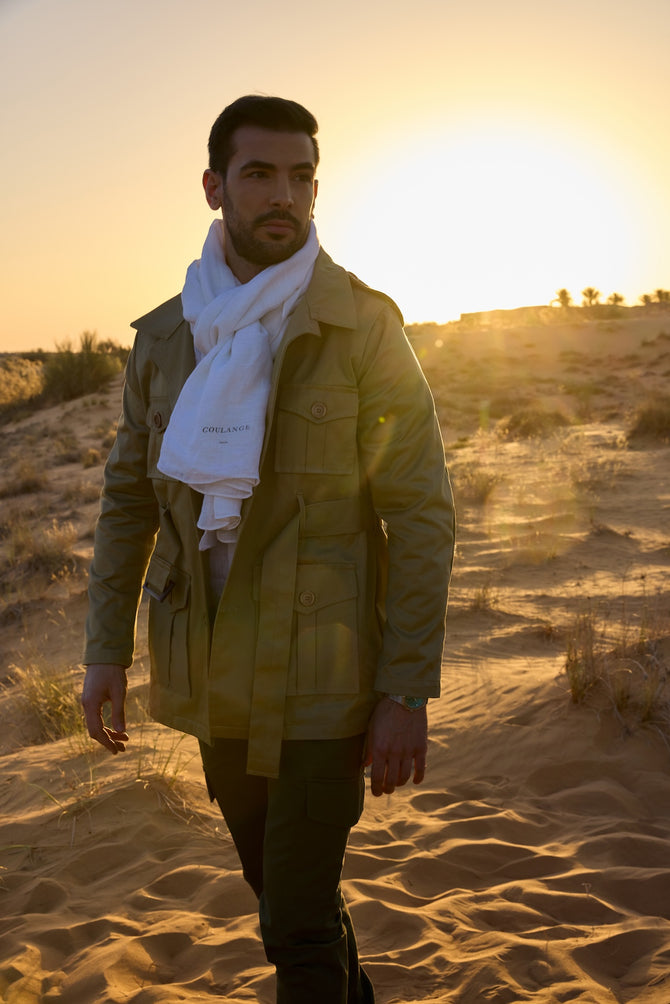
The safari jacket. Direct heir to colonial expedition jackets and then the military wardrobe, it takes up the codes of utility clothing: four patch pockets with flaps, functional buttons, epaulettes, sewn belt or drawstring at the waist. It is the most distinctive cut of a men's summer wardrobe built with discernment — the one that embodies, better than any other, the register of the chic adventurer.
The unstructured blazer. Without shoulder pads or full lining, cut close to the body but without constraint, it takes up the codes of the Italian wardrobe of the 1960s. It is the most versatile cut: it replaces the wool blazer in summer, wears as well over an open shirt as over a Mongolian cashmere t-shirt, and works in the city as well as by the seaside.
The utility jacket or "chore jacket". Straight cut, three or four patch pockets, button fastening. It is the most casual cut, ideal for weekends or travel. It is close to the French worker's wardrobe of the early 20th century revisited with discernment.
The hunting jacket or "safari jacket". Very close to the safari jacket but often with wider sleeves, with a back bellows and side bellows pockets. It fully claims the heritage of the adventure wardrobe and works particularly well on tall or athletic men.
Colours to prioritise for a men's linen jacket
Linen is a noble material that is sufficient unto itself: its most beautiful colours are those that reveal its grain and the subtlety of its drape, without overloading the silhouette.
Sand beige and ecru are the signature shades of the men's linen jacket: sunny, sober, they immediately evoke the Mediterranean wardrobe and work with the entire summer wardrobe. Light khaki and soft olive bring an expeditionary note, perfect with ecru linen trousers and brown leather derbies. Navy blue and midnight blue open the linen jacket to more formal occasions and are the only credible alternative to the wool blazer for summer dinners. Stone grey and anthracite are particularly suited to urban and professional contexts. Finally, terracotta and tobacco brown are the ideal colours for late summer and late-season travel.
Avoid very saturated colours and loud prints: the linen jacket draws its beauty from its material, never its pattern. A well-dressed man in linen is recognised first by the precision of his tones and the coherence of his silhouette.
How to wear a men's linen jacket: three proven silhouettes
Daytime, Mediterranean version. Sand beige safari jacket, off-white linen shirt open over a fine t-shirt, ecru linen trousers, loafers or natural leather sandals. A neckerchief, a simple leather-strap watch, tortoiseshell glasses. This is the silhouette of seaside lunches, walks through hilltop villages and late-season travel days. To go further on the summer linen register, our complete guide to the men's linen shirt offers useful parallel reading for building a coherent summer wardrobe.
City, urban explorer version. Khaki or olive utility jacket, fine white cotton or Mongolian cashmere t-shirt, raw denim or stone chinos, loafers or desert boots. A natural leather belt, a brushed steel watch, a waxed canvas or leather bag. This is a silhouette that claims the utility heritage of the adventure wardrobe while remaining perfectly suited to the big city — the same coherence as our guide to men's linen trousers, expressed in a single piece.
Evening, dressed-up summer version. Unstructured navy or anthracite linen blazer, white washed linen shirt open two buttons, light or stone grey linen trousers, fine smooth leather derbies or loafers. A linen pocket square slipped into the chest pocket, a dress watch with leather strap, a slim belt. This silhouette is inspired by a Mediterranean classicism that has lost none of its modernity and which can be found, extended to the entire summer wardrobe, in our guide to military style in summer.
Classic linen, washed linen, blended linen: decoding the variants
Three terms are regularly confused on labels. Classic linen offers the sharpest drape and maximum breathability; it is the reference choice for a structured jacket or safari jacket. Washed linen has undergone a softening treatment that makes it more supple to the touch from the first wear, at the cost of slightly more pronounced creasing; it is an excellent option for a utility jacket worn daily or when travelling. Blended linen (linen-cotton, linen-cool wool, linen-silk) reduces creasing and softens the drape, but reduces breathability; best reserved for the most structured jackets or mid-season blazers.
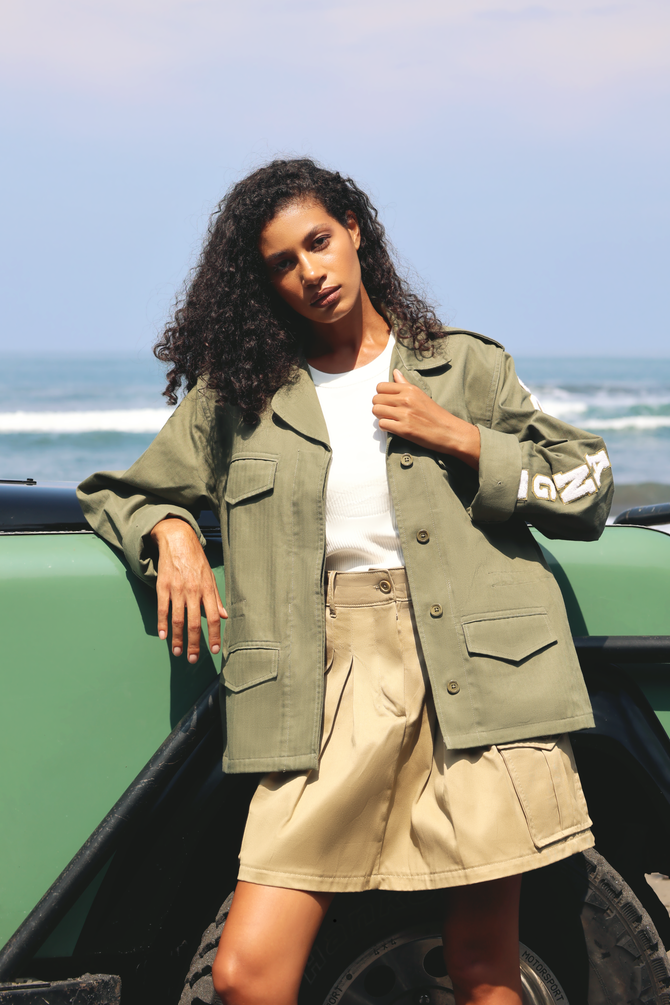
In a well-constructed summer wardrobe, the linen jacket is not an isolated piece: it naturally dialogues with a linen shirt knotted at the waist, matching linen trousers or tailored shorts for the hottest days. The purchasing logic is the same as for the other key pieces of the season, as illustrated by our guide to the women's safari jacket — useful reading for couples building their summer wardrobe together.
Caring for your linen jacket to keep it for ten summers
A quality linen jacket requires careful but reasonable maintenance. Prioritise dry cleaning once or twice a season rather than frequent domestic washing: the lining, fusible reinforcements and shoulder structure do not tolerate machine washing well. Between dry cleans, brush the jacket with a soft brush after each wear, air it on a shaped hanger overnight and use a steam de-wrinkler to refresh the drape.
For unlined utility jackets, hand washing or machine washing at 30°C maximum, without fabric softener, is possible — flat drying on a bath towel, never in a tumble dryer. Out of season, hang the jacket on a wide shaped hanger rather than folding it: linen marks easily at the folds, and a jacket stored flat will lose its shoulder structure more quickly. A cedar cushion in the chest pocket will keep moths away without masking the material.
The Coulange linen jacket: French elegance from the adventure wardrobe
At Coulange, the linen jacket is one of the emblematic pieces of the men's summer wardrobe. Our Safari Jacket is crafted in our workshop in Mayenne, cut from a fabric carefully chosen to ensure drape, opacity and freshness. Signature buttons, four patch pockets, sewn waist belt, slightly marked shoulders: every detail is designed to structure the silhouette without constraining it. Worn alone in summer over a Coulange linen shirt and B45 linen trousers, it composes an instantly recognisable chic explorer silhouette — sober, structured, deeply rooted in French craftsmanship. To explore the codes of the revisited utility wardrobe more broadly, our guide to the men's cotton safari jacket offers complementary reading useful to any man building his summer wardrobe with discernment.
FAQ about men's linen jackets
Can you wear a linen jacket to the office?
Yes, provided you choose a clean cut (unstructured blazer or sober safari jacket), a dark colour (navy, anthracite, deep khaki) and pair it with a washed linen shirt and matching trousers. Reserve sunny beiges and ecrus for more casual contexts or end-of-week days.
Should you take your usual size in a linen jacket?
Yes, generally. Linen relaxes very little after cleaning and the cut is designed for the material. Above all, avoid taking a size up for comfort: you will lose the shoulder structure and the precision of the cut. Check the shoulder line first, then the chest width, and only then the sleeve length.
Should a linen jacket really crease?
Creasing is one of linen's signatures: it is what distinguishes it from synthetic fibres that imitate its appearance. Good linen creases nobly, in soft folds that largely fade after a night on a shaped hanger. For a very formal jacket, a higher fabric weight and a linen blend considerably limit visible creasing.
Can you wear a linen jacket with jeans?
Yes, and it is even one of the most successful combinations in the men's summer wardrobe. Prefer raw or naturally faded denim, without rips, and a utility jacket or unstructured blazer rather than a very strongly typed safari jacket. With a light linen shirt and desert boots, the ensemble forms a sober, modern and deeply coherent silhouette.
Linen jacket or cotton jacket for summer: which to choose?
Linen offers superior breathability, a drier drape and far greater longevity than cotton, which sags more quickly and loses its colour over washes. Cotton remains interesting for utility jackets washed at very high frequency, but linen remains the reference choice for an investment piece destined to last several summers.
Discover our linen jackets for men in our collection.